
Lawyer SEO in 2026: What Actually Moves the Needle (And What’s a Waste of Money)

Your law firm can still be ranking well on Google and getting less website traffic than it used to.

Those two things sound like they shouldn’t happen at the same time.

But they absolutely can.

And if you’re paying an SEO company every month, this is something they should be talking to you about.

SEO has changed.

That doesn’t mean traditional rankings no longer matter. They do.

But rankings are only one piece of the picture now.

For smaller family law, estate planning, probate, and other local law firms, the goal in 2026 shouldn’t simply be “rank higher on Google.”

The goal should be to make sure potential clients can find your firm everywhere Google is showing answers.

We think about that in terms of what we call the Three Surfaces of SEO.

Before we get into those, though, we need to talk about what changed.

Why Your Google Rankings Can Be Up While Your Traffic Is Down

For years, SEO was pretty straightforward. The higher your website ranked in Google, the more likely someone was to click on it.

So SEO companies focused heavily on keyword rankings. If your firm moved from position eight to position four, that was progress. If you moved from four to two, even better.

That still matters.

But people don’t interact with Google the same way they did a few years ago.

Google now frequently displays AI-generated answers above the traditional search results.

And those answers are changing what people click.

A Pew Research Center study analyzed nearly 69,000 Google searches performed by 900 U.S. adults.

When an AI summary appeared, users clicked a traditional search result about 8% of the time.

When there was no AI summary, that number was about 15%.

Even more interesting: users clicked one of the links contained inside the AI summary itself only about 1% of the time.

You can read the full Pew Research Center study on Google AI summaries and click behavior.

This matters especially for attorneys because of the kinds of searches potential clients make.

They don’t always search:

“divorce lawyer Pittsburgh”

They also search:

“How long does probate take in Pennsylvania?”

“What happens to the house during a divorce?”

“Do I need a will if I already have a trust?”

Pew found that searches beginning with question words such as “what,” “who,” “when,” and “why” generated an AI summary about 60% of the time.

In other words, exactly the kind of educational content law firms have spent years creating is also the kind of content Google may now summarize directly on the search page.

Your ranking may not have changed.

But the number of people who need to click your website can.

That’s why we need to look at SEO differently.
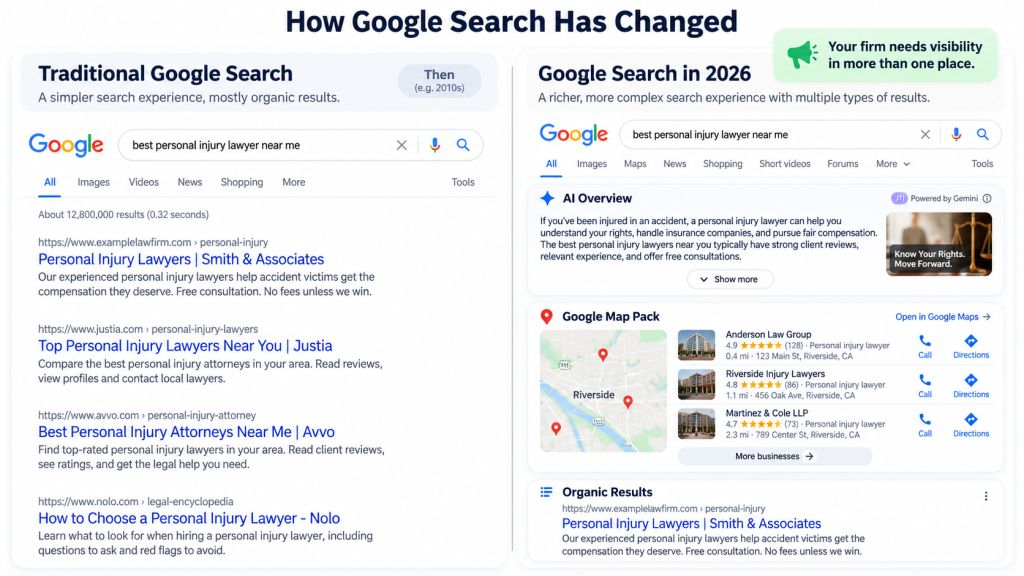
Comparison of traditional Google search results and 2026 search results with AI Overview, Google Map Pack and organic listings.

The Three Surfaces of Law Firm SEO

When someone searches for an attorney today, there are basically three major places your firm can appear.

We call them the Three Surfaces.

Surface 1: The AI AnswerThis is the AI-generated summary Google may display at the top of the page.

Instead of simply giving users a list of websites, Google attempts to answer the question for them.

Your goal is to make your law firm’s content clear, useful, well-structured, and authoritative enough that search engines can understand it and potentially use it as a source.

Surface 2: The Google Map Pack

This is the group of local businesses that appears with a map.

For a local law firm, this is incredibly important.

Someone searching for a divorce attorney, probate lawyer, or estate planning attorney often wants someone nearby.

That means your Google Business Profile, reviews, location, categories, and overall local presence matter.

Surface 3: Traditional Organic Results

These are the familiar website results underneath everything else.

We absolutely do not want to abandon traditional SEO.

Your website still needs strong practice area pages, useful content, good internal linking, legitimate backlinks, sound technical SEO, and local relevance.

The mistake is putting your entire SEO budget into Surface 3 while ignoring the other two.

Your goal should be visibility across all Three Surfaces.

And this is actually good news for smaller law firms.

You may not be able to outspend a giant personal injury firm with a seven-figure marketing budget.

But local search isn’t just about who spends the most money.

A two-attorney firm can still build an extremely strong presence in the county it actually serves.

4 Law Firm SEO Strategies That Actually Matter in 2026

So what should you be working on?

Here are four areas we think deserve your attention.

1. Treat Your Google Business Profile Like a Living Asset

Please do not treat your Google Business Profile like something you set up five years ago and never touched again.

It is one of your most important local marketing assets.

Whitespark’s 2026 Local Search Ranking Factors report surveys local SEO professionals about the factors they believe have the greatest influence on local rankings.

In that survey, Google Business Profile signals remain one of the largest categories influencing local pack visibility.

You can review the full Whitespark 2026 Local Search Ranking Factors report.

And some of the things that matter are surprisingly simple.

Start with your primary business category.

Yes, the dropdown box.

Make sure it actually describes the primary service your firm provides.

Then look at the rest of the profile.

  • Are your services listed?
  • Are your hours accurate?
  • Is your phone number correct?
  • Do you have current photos?
  • Is someone updating the profile regularly?

Before someone talks you into another complicated six-month SEO project, make sure the basics are actually right.

For a deeper look at Google Business Profile, reviews, citations, and local search, read our IFTS guide to getting your law firm found on Google and trusted by clients.

2. Focus on Getting Reviews Consistently

Attorneys sometimes look at a competitor with 300 reviews and think:

“Well, we’re never catching them.”

You don’t necessarily need to.

The better question is whether your firm is consistently generating new reviews.

If you have 75 reviews but haven’t received one in eight months, that sends a very different signal than a firm with 75 reviews that continues receiving new ones every month.

Whitespark’s 2026 survey also points to the growing importance of review signals in local search.

This doesn’t require a complicated marketing campaign.

Finish a matter.

Ask the client for a review.

Make it easy for them to leave one.

Then respond when they do.

The hardest part is usually not knowing what to do. It’s making sure someone at the firm is responsible for doing it every single time.

3. Write Content That Actually Answers the Question

This is one of the biggest changes we would make to a lot of older law firm websites.

Stop trying so hard to sound like a lawyer.

Your potential client probably isn’t searching:

“Understanding Dissolution Timelines Within the Commonwealth of Pennsylvania.”

They’re searching:

“How long does an uncontested divorce take in Pennsylvania?”

Use that as the heading.

Then answer it.

Immediately.

Don’t make someone read five paragraphs about how every legal situation is unique before giving them any useful information.

Give the potential client a clear answer…And give Google a clear answer it can understand.

That becomes even more important as AI systems attempt to extract answers directly from website content.

We go deeper into this in our article on turning your law firm website into a client-generating machine with useful content and video.

Clear content is better for people.

It is also easier for search engines and AI systems to understand.
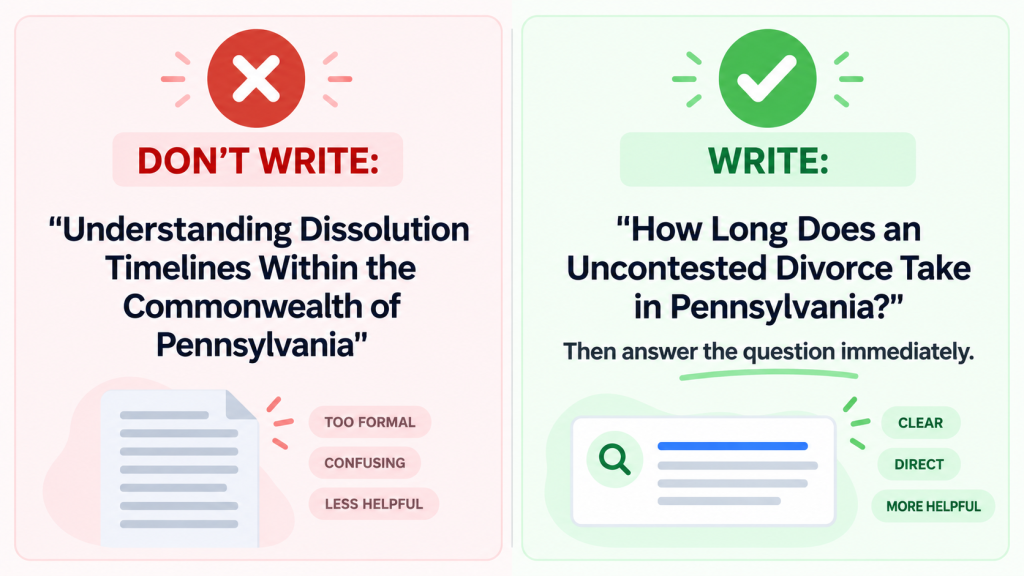
Example showing how law firms can replace complicated legal-style headings with clear questions potential clients actually search.

4. Build Boring, Legitimate Local Links

Good SEO is not always exciting.

Sometimes the best opportunities are incredibly boring.

  • Your county bar association.
  • Your local chamber of commerce.
  • A community organization you sponsor.
  • A legitimate local event.
  • A scholarship.
  • A nonprofit your firm supports.

Those links may not look impressive on an SEO report.

But they are real.

They are local.

And they actually have something to do with your business.

We would take a smaller number of legitimate, relevant local links over hundreds of mystery backlinks from websites nobody has ever heard of. While you’re at it, make sure your important business listings are accurate too.

Your firm’s name, address, and phone number should be consistent across the places that matter.

Don’t overcomplicate it.

4 SEO Expenses We Would Question

Now let’s flip this around.

If we were reviewing an SEO invoice for a law firm, there are several things that would immediately make us ask questions.

1. Publishing Content Just to Hit a Monthly Quota

More content does not automatically equal better SEO.

If your package includes 12 blogs every month, ask why.

  • Are those 12 articles answering real questions?
  • Are people reading them?
  • Are they supporting your practice area pages?
  • Are they bringing in relevant traffic?
  • Are they helping potential clients?
  • Or is someone publishing 12 articles because the contract says they owe you 12 articles?

We would rather have one genuinely useful page answering a question your clients actually ask than 12 generic articles nobody needs.

2. Treating Domain Authority Like a Business Result

Domain Authority can be a useful third-party metric.

But it is not a metric created or used by Google.

So if the big accomplishment on your SEO report is:

“Your Domain Authority increased from 22 to 28!”

Our next question would be:

Did the phone ring more?

Nobody hires a divorce attorney because they were impressed by the firm’s Domain Authority score.

Use metrics like that as diagnostic tools.

Don’t confuse them with actual business results.

3. Blasting Your Firm Into Hundreds of Directories

Accurate citations still have value.

Your law firm should have correct business information in the places people and search engines actually use.

But that does not mean you need to be submitted to 300 random directories.

Focus on the important listings.

Make sure they are accurate. Keep them accurate.

Then move on to work that has a greater impact.

4. Letting Your Marketing Company Own Your Accounts

This one has nothing to do with Google’s algorithm.

Check who owns your:

  • Domain name
  • Website
  • Google Business Profile
  • Google Analytics account
  • Google Search Console account

Your firm should have access to all of them.

Ideally, your firm should be the actual owner.

Your marketing company should have permission to work inside your accounts.

They should not own your digital presence.

At IFTS, if a client decides to leave us, their Google Business Profile does not suddenly belong to us.

Their analytics do not belong to us.

Their website doesn’t disappear because they stopped paying us.

It is their business.

It should be their property.

Stop Measuring SEO With Rankings Alone

There is one change we would encourage every small law firm to make this month.

Stop accepting a rankings report as the complete measurement of whether your SEO is working.

We still care about rankings.

We still care about traffic.

Both are useful.

But we also want to know:

  • How many phone calls came from search?
  • How many people requested directions?
  • How many contact forms were submitted?
  • Which pages generated inquiries?
  • How many inquiries were qualified?
  • How many of those prospects actually became clients?

Because the goal of your marketing is not to make a graph go up.

The goal is to help your firm bring in more of the right cases.

That is what your reporting should help you understand.
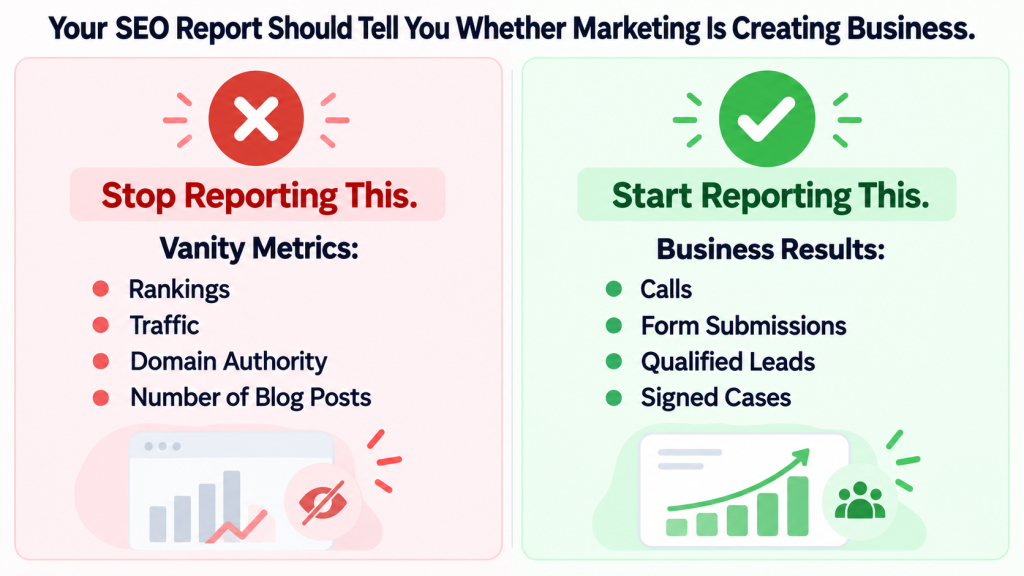
Comparison of law firm SEO vanity metrics with business metrics including calls, leads and signed cases

Good SEO in 2026 Is Mostly About Consistency

None of the things in this article are magic. You can do most of them yourself.

The challenge is doing them consistently.

  • It’s updating your Google Business Profile again next week.
  • It’s asking the next satisfied client for a review.
  • It’s improving another page next month.
  • It’s earning another legitimate local link.
  • It’s checking whether your calls and leads are actually increasing.

Then doing it again.

And again…While you’re also running a law firm.

That is really what good SEO has become.

Not one secret trick.

Not one giant batch of backlinks.

Not publishing another 50 mediocre blogs.

It is consistently making your law firm stronger across the Three Surfaces where potential clients are actually finding attorneys:

  • AI answers.
  • The Google Map Pack.
  • Traditional organic search.

How Does Your Law Firm Look Across the Three Surfaces?

If you aren’t sure, we can take a look.

IFTS offers a free SEO audit call where we review your Google Business Profile, reviews, website, and current search visibility.

We’ll show you where your firm is already doing well and where you may be missing opportunities.

No complicated lead magnet.

No 37-page automated report that tells you nothing.

Just a conversation about what we see and what we would prioritize.

Schedule Your Free Law Firm SEO Audit: https://iftsdesign.com/get-more-clients 

How Law Firms Can Use AI Ethically for Marketing (Without Getting Burned)

Key Takeaway

AI is not replacing attorneys—but it is helping law firms scale the content and expertise they already have more efficiently. When used ethically, AI can help firms repurpose approved blogs, FAQs, videos, and attorney insights into marketing assets that save time and improve consistency. The key is using AI to support human expertise—not replace it.

A few years ago, attorneys made headlines after submitting court filings that cited fake cases generated by AI. The judge was not amused. The attorneys were sanctioned, fined, and the story quickly spread across the legal industry. Reuters covered the situation here.

And honestly? 

That story is one of the reasons many attorneys hear the term “AI” and immediately think:

“Yeah…absolutely not.”

Which is understandable.

Because if AI is used carelessly, it definitely can create problems.

But here’s the thing: That wasn’t really an AI problem.

It was a how-you-use-it problem.

And I think that distinction is incredibly important for law firms right now.

AI Has Become a Buzzword (Which Is Part of the Problem)

At this point, it feels like every company on earth is talking about:

  • AI
  • ChatGPT
  • Gemini
  • Grok
  • Perplexity
  • Avatars
  • AI twins
  • automation

…and because of that, the conversation has become either:

  1. wildly overhyped
    or
  2. unnecessarily scary

But at a very basic level, most AI tools are really just systems designed to help process, organize, and repurpose information faster.

That’s it.

And from a marketing standpoint, that can be extremely useful for law firms.

Can Law Firms Use AI Ethically for Marketing?

Yes—but the key word is ethically.

There is a massive difference between:

  • using AI to help organize and distribute approved content
    and
  • blindly publishing AI-generated legal information without attorney oversight

The firms that are using AI successfully right now are typically using it as:

  • a time-saving tool
  • a content repurposing tool
  • or a consistency tool

Not as a replacement for actual legal expertise.

And honestly, that’s where I think a lot of the public conversation around AI gets off track.

AI should support human expertise—not replace it.

Where AI Actually Makes Sense for Law Firms

One of the biggest misconceptions right now is that AI is supposed to replace attorneys.

That’s NOT how we think law firms should use it at all.

In our opinion, the best use of AI for law firms is helping distribute and scale expertise the attorney already has.

For example, most firms already have a huge amount of valuable content sitting around:

  • blog posts
  • FAQs
  • webinar recordings
  • newsletters
  • consultation explanations
  • speaking engagements
  • intake conversations

The problem is not usually a lack of expertise.

The problem is that attorneys don’t have enough time to consistently turn all of that information into marketing assets.

That’s where AI becomes useful.

Practical Ways Law Firms Are Using AI Right Now

When used correctly, AI can help law firms:

  • turn blogs into video scripts
  • repurpose FAQs into social media posts
  • create YouTube descriptions
  • summarize webinar transcripts
  • generate email follow-up sequences
  • organize content ideas faster

And that time savings adds up quickly.

For example, instead of spending hours manually rewriting a blog into multiple pieces of content, AI can help your team create a first draft in minutes.

That does not mean the attorney should blindly publish everything AI generates.

It simply means the firm can move faster operationally.

And honestly, for many law firms, consistency is one of the biggest marketing challenges.

The Ethical Line Matters For Law Firms

This is the part that really matters.

There’s a massive difference between:

  • using AI to scale approved attorney messaging or existing content
    and
  • using AI to invent legal advice

Those are not the same thing.

At IFTS, the way we recommend using AI is actually very controlled.

For example, when we help firms create AI avatar videos or AI twins, we only allow the AI to say things the attorney has already said.

Usually, we start with:

  • existing blogs
  • approved FAQs
  • webinar recordings
  • previously recorded attorney content

Then we use AI to help repurpose that material into:

  • YouTube videos
  • social clips
  • educational content
  • follow-up sequences

The AI is not inventing legal opinions or creating legal strategy.

It’s helping the firm scale information the attorney has already approved.

That distinction is extremely important.

AI Avatars Are Probably Less “Fake” Than People Think

A lot of attorneys hear the term “AI avatar” and immediately picture some completely fake lawyer giving legal advice online.

That’s not what we recommend at all.

The reality is that modern AI avatar platforms like HeyGen are essentially content scaling tools.

An attorney can record once, and then the firm can create multiple educational videos from that approved content without constantly filming new material every week.

And honestly, that solves a very real operational problem.

Because most attorneys:

  • do not have time to film constantly
  • do not want to spend hours editing content
  • and are not trying to become full-time influencers

They’re trying to run a law firm.

The Real Advantage of AI: Consistency

In our experience, the biggest advantage AI gives law firms is not “magic.”

It’s consistency.

Most firms already know enough to create valuable content.

The challenge is:

  • creating it consistently
  • distributing it consistently
  • and staying visible consistently

AI helps reduce the operational bottleneck behind all of that.

For example:

  • one webinar can become multiple blog posts
  • one FAQ can become a short-form video
  • one long-form video can become weeks of social content

That kind of repurposing can dramatically increase the amount of visibility a law firm gets from content it has already created.

And visibility matters.

Because the firms that consistently show up are often the firms that stay top-of-mind when someone finally needs legal help.

You can see how we approach this in:

Where Law Firms Should Be Careful

Now, with all of that said, there are absolutely places where AI should not be used carelessly.

For example:

  • blindly publishing AI-written legal content
  • relying on AI legal research without verification
  • allowing AI to create information the attorney never reviewed
  • using AI-generated content without human oversight

That’s where firms can get themselves into trouble.

AI should support human expertise—not replace it.

And honestly, I think that’s the biggest takeaway here.

The firms that are going to benefit most from AI are not the firms trying to replace humans.

They’re the firms using AI to amplify human expertise more efficiently.

The Bottom Line When It Comes To AI

AI is not some magical replacement for attorneys.

But it is becoming an incredibly powerful tool for:

  • saving time
  • improving consistency
  • scaling approved messaging
  • and helping firms distribute their expertise more efficiently

And I think the firms that approach AI thoughtfully—and ethically—are going to have a major advantage over the next few years.

Not because AI replaces expertise.

But because it helps more people see it.

Want Help Implementing This Ethically?

At IFTS, we help law firms use video, AI, and content marketing systems to generate more visibility and more consultations—without creating more work for the attorneys themselves.

If you’d like to see how we’re implementing this for firms right now, you can check out our:  Law Firm Client Kickstarter Kit

We only work with one law firm per practice area per county, so availability is limited.

Frequently Asked Questions

Yes. Many law firms are using AI ethically to help repurpose approved content, organize marketing materials, create video scripts, and improve consistency. The key is ensuring attorneys review and approve the content before publishing.

AI avatars can be used ethically when they are based on approved attorney content and are not inventing legal advice. Many firms use AI avatars to scale educational marketing content without constantly filming new videos.

Law firms should avoid blindly publishing AI-generated legal content, relying on AI without attorney review, or using AI to create legal advice that was never approved by an attorney.

Yes. AI can help law firms turn blogs, FAQs, webinars, and recorded content into video scripts, social posts, email sequences, and other marketing materials much more efficiently.

No. The most effective use of AI in legal marketing is supporting and amplifying human expertise—not replacing it.

In many cases, the biggest advantage is consistency. AI helps firms create and distribute content more efficiently so they can stay visible without dramatically increasing workload.

This article is for general marketing education only and is not legal ethics advice. Law firms should review AI usage under their applicable bar rules and internal policies.

How Lawyers Can Create LinkedIn Content in Under 60 Seconds (Without Writing Long Posts)

Many attorneys know they should be posting on LinkedIn.

They’ve heard it helps build authority.
They know it keeps them visible to referral partners.
And they understand it can help attract potential clients.

But most lawyers still don’t post consistently.

Why?

Because they think every LinkedIn post needs to be a long, polished article.

So they sit down to write something.

Then they start overthinking it.

They try to make it sound perfect.
They worry about wording.
They worry about how it will look to colleagues.

And before long, the post never gets published.

Sound familiar?

The reality is that some of the most effective LinkedIn content is actually very short.

In fact, many highly respected professionals build authority with posts that are only three to five sentences long.

For busy attorneys—especially those in small law firms with two to five lawyers—this approach can make LinkedIn marketing far easier and far more sustainable.

Let’s look at how it works.

Why Most Lawyers Struggle to Post on LinkedIn

For most attorneys, the biggest obstacle isn’t a lack of ideas.

It’s the belief that every post needs to be perfectly written.

That mindset creates several problems.

The Perfection Problem

Many attorneys assume LinkedIn posts need to be:

  • Highly polished
  • Carefully structured
  • Long and detailed
  • Written like a formal article

The result?

Posting starts to feel like a large project instead of a quick activity.

And when something feels like a large project, it keeps getting pushed down the to-do list.

Eventually, posting becomes something that happens:

  • Once every few months
  • Only when there’s a major announcement
  • Or sometimes not at all

The problem with this approach is simple.

Visibility disappears.

When attorneys stop showing up online, potential clients and referral partners stop seeing them.

Why Short LinkedIn Posts Work Better for Attorneys

Here’s the good news.

You don’t need to write a long article every time you post.

In fact, some of the most effective posts on LinkedIn are what we call micro-posts.

What Is a LinkedIn Micro-Post?

A micro-post is a short LinkedIn post that usually contains:

  • Three to five sentences
  • One simple idea
  • Clear, easy-to-read language

That’s it.

No long introduction.

No complicated formatting.

Just a quick insight.

Why These Posts Work

Short posts perform well for several reasons.

First, they are easy to read.

Most people scroll LinkedIn quickly. When they see a short post, they’re far more likely to read it.

Second, they feel authentic.

A short insight feels more like a real conversation and less like marketing.

Third, they allow attorneys to post consistently.

And consistency is what builds trust.

When people see you regularly sharing insights about your area of law, they start to view you as a trusted expert.

A Simple 60-Second LinkedIn Framework for Lawyers

Creating LinkedIn content doesn’t have to be complicated.

Here’s a simple framework attorneys can follow.

Step 1: Pick One Small Idea

Think about something that happened recently in your practice.

It could be:

  • A client question
  • A common misunderstanding
  • A lesson from a case
  • A mistake you often see people make

You don’t need to cover an entire legal topic.

Just focus on one small idea.

Step 2: Write Three to Five Sentences

Explain the idea briefly.

Think of it like answering a question a client might ask.

Keep it simple.

Step 3: Post It

That’s it.

No overthinking.
No rewriting ten times.

Just post it.

When attorneys follow this framework, creating LinkedIn content usually takes less than a minute.

Five Easy LinkedIn Post Ideas Lawyers Can Use Anytime

One of the biggest concerns attorneys have is not knowing what to write about.

The good news is that ideas are everywhere in your daily work.

Here are five simple topics you can use anytime you want to create a LinkedIn post.

1. A Lesson From a Client Conversation

Client conversations are full of useful insights.

For example:

  • A question someone asked
  • A misunderstanding about the law
  • A situation that could have been avoided

These conversations often make excellent short posts.

Example prompt:

“A client asked me something interesting this week…”

2. A Common Misconception About Your Practice Area

Every area of law has myths and misconceptions.

Clearing up those misconceptions can make for very effective LinkedIn posts.

Example prompt:

“Many people believe ______ about the law, but the reality is…”

This type of post shows expertise while also educating your audience.

3. A Mistake You See People Make Frequently

Attorneys often notice the same mistakes happening repeatedly.

For example:

  • Business owners signing contracts without review
  • Individuals waiting too long to create an estate plan
  • Companies ignoring compliance requirements

Sharing these insights can help people avoid problems.

Example prompt:

“One mistake I see people make all the time is…”

4. Something That Changed Your Perspective as a Lawyer

Personal insights can be powerful.

Think about something you believed earlier in your career that changed over time.

Example prompt:

“Early in my career I believed ______. Over time, I realized ______.”

Posts like this help humanize attorneys and make them more approachable.

5. A Question Clients Ask All the Time

Every attorney hears certain questions repeatedly.

Those questions can easily become LinkedIn posts.

For example:

  • “Do I really need a contract for this?”
  • “Is estate planning only for wealthy people?”
  • “When should a business hire a lawyer?”

Answer the question in three or four sentences.

That’s your post.

Example LinkedIn Micro-Posts for Attorneys

To make this even easier, here are two examples

Business Attorney Example

Many business owners think contracts only matter when something goes wrong.

But the best contracts actually prevent disputes before they start.

Clear expectations protect both sides and save time and money.

A well-written contract is one of the simplest ways to avoid expensive legal problems later.

Estate Planning Attorney Example

Many people believe estate planning is only for wealthy families.

But the real purpose of an estate plan is to make things easier for the people you love.

Clear instructions today can prevent confusion, conflict, and costly delays later.

Planning ahead is one of the most thoughtful decisions you can make for your family.

These posts take less than a minute to write—but they still demonstrate expertise.

Why Consistency Matters More Than Length

Many attorneys worry that short posts won’t be impressive enough.

But the truth is that consistency is far more powerful than length.

When attorneys show up regularly on LinkedIn:

  • Referral partners remember them
  • Prospects see their expertise
  • Their network becomes familiar with their practice

Over time, those small posts build credibility.

And credibility leads to trust.

Trust is what ultimately leads someone to call a lawyer when they need help.

Short posts allow attorneys to stay visible without spending hours writing.

How Attorneys Can Generate LinkedIn Posts Even Faster

Even with a simple framework, some attorneys still struggle to come up with ideas.

That’s why we created a free tool designed specifically for lawyers.

The Attorney Authority Post Builder GPT helps attorneys generate LinkedIn posts in seconds.

Instead of staring at a blank screen, you simply enter a topic or question.

The tool then produces a short LinkedIn post you can edit and publish.

You can try it here:

https://lp.iftsdesign.com/attorney-authority-post-builder

Many attorneys find that using a tool like this helps them stay consistent without spending time brainstorming.

Final Thoughts: Consistency Beats Perfection

If you remember one thing from this article, remember this:

You don’t need to write a long article every time you post on LinkedIn.

Sometimes a few thoughtful sentences are more than enough.

Short posts can:

  • Demonstrate expertise
  • Keep you visible to referral partners
  • Build trust with potential clients

The key is simply showing up consistently.

If you want to try this today, open LinkedIn and write a post based on a conversation or question you had this week.

Keep it simple.

Three to five sentences.

Post it.

Then do it again next week.

Over time, those small posts can become one of the easiest and most effective marketing strategies for your law firm.