
How Law Firms Can Use AI Ethically for Marketing (Without Getting Burned)

Key Takeaway

AI is not replacing attorneys—but it is helping law firms scale the content and expertise they already have more efficiently. When used ethically, AI can help firms repurpose approved blogs, FAQs, videos, and attorney insights into marketing assets that save time and improve consistency. The key is using AI to support human expertise—not replace it.

A few years ago, attorneys made headlines after submitting court filings that cited fake cases generated by AI. The judge was not amused. The attorneys were sanctioned, fined, and the story quickly spread across the legal industry. Reuters covered the situation here.

And honestly? 

That story is one of the reasons many attorneys hear the term “AI” and immediately think:

“Yeah…absolutely not.”

Which is understandable.

Because if AI is used carelessly, it definitely can create problems.

But here’s the thing: That wasn’t really an AI problem.

It was a how-you-use-it problem.

And I think that distinction is incredibly important for law firms right now.

AI Has Become a Buzzword (Which Is Part of the Problem)

At this point, it feels like every company on earth is talking about:

  • AI
  • ChatGPT
  • Gemini
  • Grok
  • Perplexity
  • Avatars
  • AI twins
  • automation

…and because of that, the conversation has become either:

  1. wildly overhyped
    or
  2. unnecessarily scary

But at a very basic level, most AI tools are really just systems designed to help process, organize, and repurpose information faster.

That’s it.

And from a marketing standpoint, that can be extremely useful for law firms.
Can Law Firms Use AI Ethically for Marketing?

Yes—but the key word is ethically.

There is a massive difference between:

  • using AI to help organize and distribute approved content
    and
  • blindly publishing AI-generated legal information without attorney oversight

The firms that are using AI successfully right now are typically using it as:

  • a time-saving tool
  • a content repurposing tool
  • or a consistency tool

Not as a replacement for actual legal expertise.

And honestly, that’s where I think a lot of the public conversation around AI gets off track.

AI should support human expertise—not replace it.

Where AI Actually Makes Sense for Law Firms

One of the biggest misconceptions right now is that AI is supposed to replace attorneys.

That’s NOT how we think law firms should use it at all.

In our opinion, the best use of AI for law firms is helping distribute and scale expertise the attorney already has.

For example, most firms already have a huge amount of valuable content sitting around:

  • blog posts
  • FAQs
  • webinar recordings
  • newsletters
  • consultation explanations
  • speaking engagements
  • intake conversations

The problem is not usually a lack of expertise.

The problem is that attorneys don’t have enough time to consistently turn all of that information into marketing assets.

That’s where AI becomes useful.

Practical Ways Law Firms Are Using AI Right Now

When used correctly, AI can help law firms:

  • turn blogs into video scripts
  • repurpose FAQs into social media posts
  • create YouTube descriptions
  • summarize webinar transcripts
  • generate email follow-up sequences
  • organize content ideas faster

And that time savings adds up quickly.

For example, instead of spending hours manually rewriting a blog into multiple pieces of content, AI can help your team create a first draft in minutes.

That does not mean the attorney should blindly publish everything AI generates.

It simply means the firm can move faster operationally.

And honestly, for many law firms, consistency is one of the biggest marketing challenges.

The Ethical Line Matters For Law Firms

This is the part that really matters.

There’s a massive difference between:

  • using AI to scale approved attorney messaging or existing content
    and
  • using AI to invent legal advice

Those are not the same thing.

At IFTS, the way we recommend using AI is actually very controlled.

For example, when we help firms create AI avatar videos or AI twins, we only allow the AI to say things the attorney has already said.

Usually, we start with:

  • existing blogs
  • approved FAQs
  • webinar recordings
  • previously recorded attorney content

Then we use AI to help repurpose that material into:

  • YouTube videos
  • social clips
  • educational content
  • follow-up sequences

The AI is not inventing legal opinions or creating legal strategy.

It’s helping the firm scale information the attorney has already approved.

That distinction is extremely important.
AI Avatars Are Probably Less “Fake” Than People Think

A lot of attorneys hear the term “AI avatar” and immediately picture some completely fake lawyer giving legal advice online.

That’s not what we recommend at all.

The reality is that modern AI avatar platforms like HeyGen are essentially content scaling tools.

An attorney can record once, and then the firm can create multiple educational videos from that approved content without constantly filming new material every week.

And honestly, that solves a very real operational problem.

Because most attorneys:

  • do not have time to film constantly
  • do not want to spend hours editing content
  • and are not trying to become full-time influencers

They’re trying to run a law firm.

The Real Advantage of AI: Consistency

In our experience, the biggest advantage AI gives law firms is not “magic.”

It’s consistency.

Most firms already know enough to create valuable content.

The challenge is:

  • creating it consistently
  • distributing it consistently
  • and staying visible consistently

AI helps reduce the operational bottleneck behind all of that.

For example:

  • one webinar can become multiple blog posts
  • one FAQ can become a short-form video
  • one long-form video can become weeks of social content

That kind of repurposing can dramatically increase the amount of visibility a law firm gets from content it has already created.

And visibility matters.

Because the firms that consistently show up are often the firms that stay top-of-mind when someone finally needs legal help.

You can see how we approach this in:

Where Law Firms Should Be Careful

Now, with all of that said, there are absolutely places where AI should not be used carelessly.

For example:

  • blindly publishing AI-written legal content
  • relying on AI legal research without verification
  • allowing AI to create information the attorney never reviewed
  • using AI-generated content without human oversight

That’s where firms can get themselves into trouble.

AI should support human expertise—not replace it.

And honestly, I think that’s the biggest takeaway here.

The firms that are going to benefit most from AI are not the firms trying to replace humans.

They’re the firms using AI to amplify human expertise more efficiently.

The Bottom Line When It Comes To AI

AI is not some magical replacement for attorneys.

But it is becoming an incredibly powerful tool for:

  • saving time
  • improving consistency
  • scaling approved messaging
  • and helping firms distribute their expertise more efficiently

And I think the firms that approach AI thoughtfully—and ethically—are going to have a major advantage over the next few years.

Not because AI replaces expertise.

But because it helps more people see it.

Want Help Implementing This Ethically?

At IFTS, we help law firms use video, AI, and content marketing systems to generate more visibility and more consultations—without creating more work for the attorneys themselves.

If you’d like to see how we’re implementing this for firms right now, you can check out our:  Law Firm Client Kickstarter Kit

We only work with one law firm per practice area per county, so availability is limited.

Frequently Asked Questions

Yes. Many law firms are using AI ethically to help repurpose approved content, organize marketing materials, create video scripts, and improve consistency. The key is ensuring attorneys review and approve the content before publishing.

AI avatars can be used ethically when they are based on approved attorney content and are not inventing legal advice. Many firms use AI avatars to scale educational marketing content without constantly filming new videos.

Law firms should avoid blindly publishing AI-generated legal content, relying on AI without attorney review, or using AI to create legal advice that was never approved by an attorney.

Yes. AI can help law firms turn blogs, FAQs, webinars, and recorded content into video scripts, social posts, email sequences, and other marketing materials much more efficiently.

No. The most effective use of AI in legal marketing is supporting and amplifying human expertise—not replacing it.

In many cases, the biggest advantage is consistency. AI helps firms create and distribute content more efficiently so they can stay visible without dramatically increasing workload.

This article is for general marketing education only and is not legal ethics advice. Law firms should review AI usage under their applicable bar rules and internal policies.


How Lawyers Can Create LinkedIn Content in Under 60 Seconds (Without Writing Long Posts)

Many attorneys know they should be posting on LinkedIn.

They’ve heard it helps build authority.
They know it keeps them visible to referral partners.
And they understand it can help attract potential clients.

But most lawyers still don’t post consistently.

Why?

Because they think every LinkedIn post needs to be a long, polished article.

So they sit down to write something.

Then they start overthinking it.

They try to make it sound perfect.
They worry about wording.
They worry about how it will look to colleagues.

And before long, the post never gets published.

Sound familiar?

The reality is that some of the most effective LinkedIn content is actually very short.

In fact, many highly respected professionals build authority with posts that are only three to five sentences long.

For busy attorneys—especially those in small law firms with two to five lawyers—this approach can make LinkedIn marketing far easier and far more sustainable.

Let’s look at how it works.

Why Most Lawyers Struggle to Post on LinkedIn

For most attorneys, the biggest obstacle isn’t a lack of ideas.

It’s the belief that every post needs to be perfectly written.

That mindset creates several problems.

The Perfection Problem

Many attorneys assume LinkedIn posts need to be:

  • Highly polished
  • Carefully structured
  • Long and detailed
  • Written like a formal article

The result?

Posting starts to feel like a large project instead of a quick activity.

And when something feels like a large project, it keeps getting pushed down the to-do list.

Eventually, posting becomes something that happens:

  • Once every few months
  • Only when there’s a major announcement
  • Or sometimes not at all

The problem with this approach is simple.

Visibility disappears.

When attorneys stop showing up online, potential clients and referral partners stop seeing them.

Why Short LinkedIn Posts Work Better for Attorneys

Here’s the good news.

You don’t need to write a long article every time you post.

In fact, some of the most effective posts on LinkedIn are what we call micro-posts.

What Is a LinkedIn Micro-Post?

A micro-post is a short LinkedIn post that usually contains:

  • Three to five sentences
  • One simple idea
  • Clear, easy-to-read language

That’s it.

No long introduction.

No complicated formatting.

Just a quick insight.

Why These Posts Work

Short posts perform well for several reasons.

First, they are easy to read.

Most people scroll LinkedIn quickly. When they see a short post, they’re far more likely to read it.

Second, they feel authentic.

A short insight feels more like a real conversation and less like marketing.

Third, they allow attorneys to post consistently.

And consistency is what builds trust.

When people see you regularly sharing insights about your area of law, they start to view you as a trusted expert.

A Simple 60-Second LinkedIn Framework for Lawyers

Creating LinkedIn content doesn’t have to be complicated.

Here’s a simple framework attorneys can follow.

Step 1: Pick One Small Idea

Think about something that happened recently in your practice.

It could be:

  • A client question
  • A common misunderstanding
  • A lesson from a case
  • A mistake you often see people make

You don’t need to cover an entire legal topic.

Just focus on one small idea.

Step 2: Write Three to Five Sentences

Explain the idea briefly.

Think of it like answering a question a client might ask.

Keep it simple.

Step 3: Post It

That’s it.

No overthinking.
No rewriting ten times.

Just post it.

When attorneys follow this framework, creating LinkedIn content usually takes less than a minute.

Five Easy LinkedIn Post Ideas Lawyers Can Use Anytime

One of the biggest concerns attorneys have is not knowing what to write about.

The good news is that ideas are everywhere in your daily work.

Here are five simple topics you can use anytime you want to create a LinkedIn post.

1. A Lesson From a Client Conversation

Client conversations are full of useful insights.

For example:

  • A question someone asked
  • A misunderstanding about the law
  • A situation that could have been avoided

These conversations often make excellent short posts.

Example prompt:

“A client asked me something interesting this week…”

2. A Common Misconception About Your Practice Area

Every area of law has myths and misconceptions.

Clearing up those misconceptions can make for very effective LinkedIn posts.

Example prompt:

“Many people believe ______ about the law, but the reality is…”

This type of post shows expertise while also educating your audience.

3. A Mistake You See People Make Frequently

Attorneys often notice the same mistakes happening repeatedly.

For example:

  • Business owners signing contracts without review
  • Individuals waiting too long to create an estate plan
  • Companies ignoring compliance requirements

Sharing these insights can help people avoid problems.

Example prompt:

“One mistake I see people make all the time is…”

4. Something That Changed Your Perspective as a Lawyer

Personal insights can be powerful.

Think about something you believed earlier in your career that changed over time.

Example prompt:

“Early in my career I believed ______. Over time, I realized ______.”

Posts like this help humanize attorneys and make them more approachable.

5. A Question Clients Ask All the Time

Every attorney hears certain questions repeatedly.

Those questions can easily become LinkedIn posts.

For example:

  • “Do I really need a contract for this?”
  • “Is estate planning only for wealthy people?”
  • “When should a business hire a lawyer?”

Answer the question in three or four sentences.

That’s your post.

Example LinkedIn Micro-Posts for Attorneys

To make this even easier, here are two examples

Business Attorney Example

Many business owners think contracts only matter when something goes wrong.

But the best contracts actually prevent disputes before they start.

Clear expectations protect both sides and save time and money.

A well-written contract is one of the simplest ways to avoid expensive legal problems later.

Estate Planning Attorney Example

Many people believe estate planning is only for wealthy families.

But the real purpose of an estate plan is to make things easier for the people you love.

Clear instructions today can prevent confusion, conflict, and costly delays later.

Planning ahead is one of the most thoughtful decisions you can make for your family.

These posts take less than a minute to write—but they still demonstrate expertise.

Why Consistency Matters More Than Length

Many attorneys worry that short posts won’t be impressive enough.

But the truth is that consistency is far more powerful than length.

When attorneys show up regularly on LinkedIn:

  • Referral partners remember them
  • Prospects see their expertise
  • Their network becomes familiar with their practice

Over time, those small posts build credibility.

And credibility leads to trust.

Trust is what ultimately leads someone to call a lawyer when they need help.

Short posts allow attorneys to stay visible without spending hours writing.

How Attorneys Can Generate LinkedIn Posts Even Faster

Even with a simple framework, some attorneys still struggle to come up with ideas.

That’s why we created a free tool designed specifically for lawyers.

The Attorney Authority Post Builder GPT helps attorneys generate LinkedIn posts in seconds.

Instead of staring at a blank screen, you simply enter a topic or question.

The tool then produces a short LinkedIn post you can edit and publish.

You can try it here:

https://lp.iftsdesign.com/attorney-authority-post-builder

Many attorneys find that using a tool like this helps them stay consistent without spending time brainstorming.

Final Thoughts: Consistency Beats Perfection

If you remember one thing from this article, remember this:

You don’t need to write a long article every time you post on LinkedIn.

Sometimes a few thoughtful sentences are more than enough.

Short posts can:

  • Demonstrate expertise
  • Keep you visible to referral partners
  • Build trust with potential clients

The key is simply showing up consistently.

If you want to try this today, open LinkedIn and write a post based on a conversation or question you had this week.

Keep it simple.

Three to five sentences.

Post it.

Then do it again next week.

Over time, those small posts can become one of the easiest and most effective marketing strategies for your law firm.

How Often Should Lawyers Post on LinkedIn? The Data-Backed Answer for Small Law Firms

Over 1 billion professionals are on LinkedIn, but only 2% of them post content weekly. For small law firms, this is a huge opportunity to stand out.  However, If you’re like many attorneys, you know you should be posting more on LinkedIn, but you aren’t quite sure how often is enough — or what to post.

A common worry that we hear is that you might “annoy” your followers.  However, unless your post goes viral, it is typically seen by less than 6% of your overall network.

You might also worry about running out of ideas or simply not having the time to keep up with it all.

When it comes to LinkedIn, here’s the thing: the more consistently you post, the more visibility and engagement your law firm will get.

This isn’t just a hunch — it’s backed by data, which we are about to show you

In this article, we’ll cover:

  • How often lawyers from small to mid-sized firms should post on LinkedIn for maximum engagement
  • The exact numbers behind why posting frequency matters
  • What types of content perform best for attorneys
  • A simple way to keep your firm visible without spending hours each week creating posts

Why LinkedIn Matters for Lawyers

LinkedIn is no longer just a place to upload your resume.

For attorneys and law firms, it’s a powerful platform for:

  • Attracting new clients who search for answers and help directly on LinkedIn and Google
  • Building referral relationships with other professionals
  • Demonstrating credibility and expertise to potential clients and colleagues
  • Staying top-of-mind with past clients and your local network

With over 1 billion members worldwide and a professional audience that trusts the platform, LinkedIn is one of the best places for small law firms to market themselves – especially when you don’t have a huge ad budget.

However, there’s a catch: having a profile isn’t enough.

To get real results, you need to post regularly.

Let’s Get Into The Data: Why Posting More Drives More Engagement

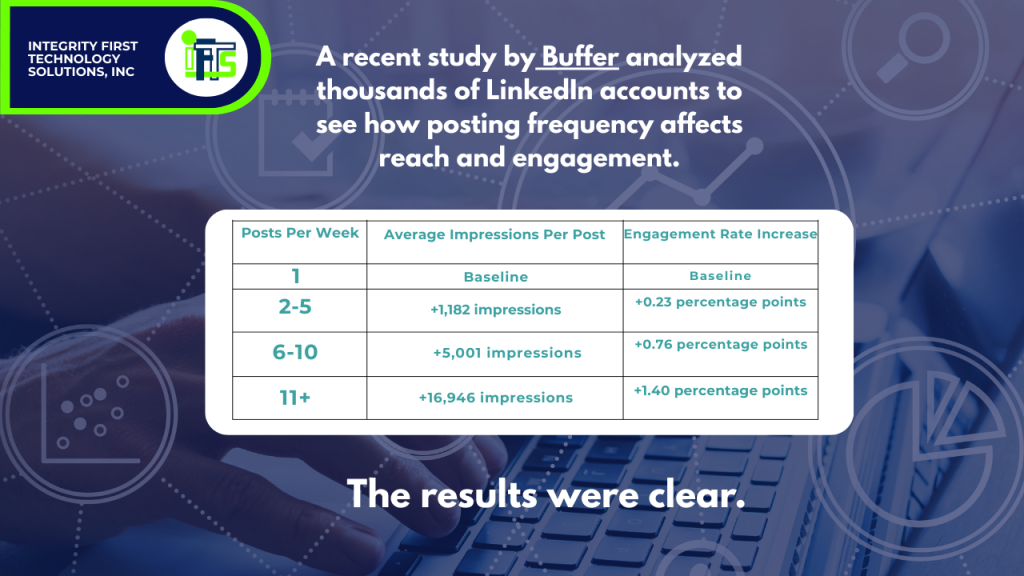
A recent study by Buffer analyzed thousands of LinkedIn accounts to see how posting frequency affects reach and engagement.

The results were clear:

Takeaway:
Posting just 2-5 times per week results in a noticeable boost in visibility!

Attorneys that go beyond 6 posts per week see exponential growth — up to 3× more engagement compared to posting only once per week.

This growth happens whether you have 200 followers or 20,000. In other words, small firms benefit just as much as large firms.

For small law firms, this means that even a modest increase in posting frequency can dramatically expand your visibility — without spending more on ads!

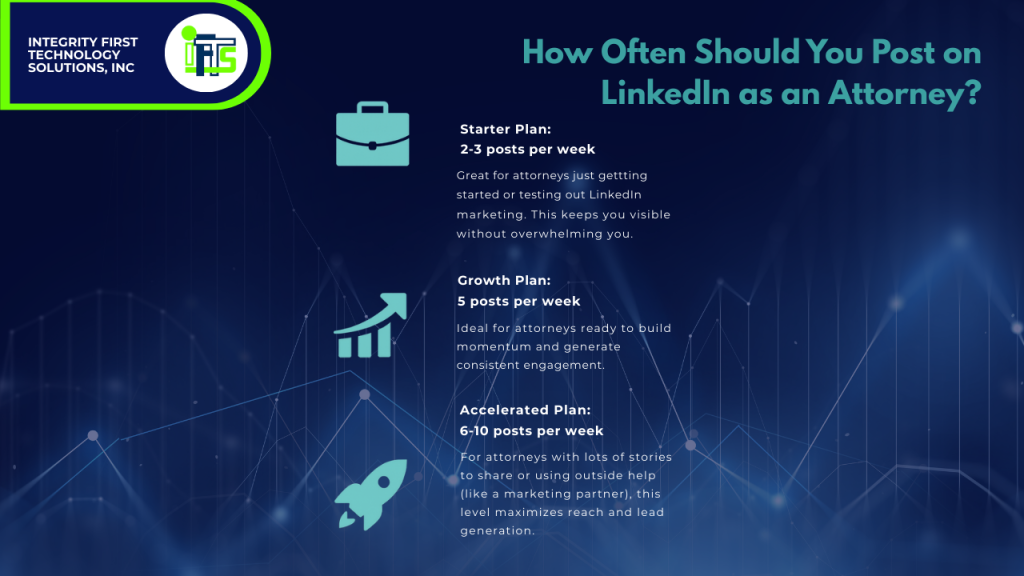
How Often Should You Post on LinkedIn as an Attorney?

If you belong to a firm with 10 or fewer attorneys, here’s a realistic way to think about posting frequency:

  • Starter Plan: 2-3 posts per week
    Great for attorneys just getting started or testing out LinkedIn marketing. This keeps you visible without overwhelming you
  • Growth Plan: 5 posts per week
    Ideal for attorneys ready to build momentum and generate consistent engagement.

Accelerated Plan: 6-10 posts per week
For attorneys with lots of stories to share or using outside help (like a marketing partner), this level maximizes reach and lead generation.


If you’re currently posting only once or twice a month, aim to start small and ramp up gradually. Consistency matters more than perfection.

What to Post on LinkedIn: Ideas Just for Attorneys

One of the biggest questions lawyers always have is: “What do I even post about?”

Here are proven content types that work well for law firms:

1. Educational Tips & FAQs

  • Example: “What to Do If You’re Involved in a Car Accident: 3 Quick Steps”
  • These establish you as a trusted expert while being genuinely helpful.

2. Myth-Busting Posts

  • Example: “3 Common Misconceptions About Estate Planning”
  • Great for engagement because they spark curiosity.

3. Behind-the-Scenes Firm Culture

Showcase your team, firm events, or community involvement to humanize your practice.  Clients love to see the “human” side of the firm.

4. Case Studies or Success Stories

Share anonymized examples of how you’ve helped clients.

5. Video Clips

  • Short, educational videos get higher engagement and help prospects feel like they “know” you before ever meeting you.

Here’s an example from one of our clients: https://www.youtube.com/watch?v=xsDLQDPM47c

6. Thought Leadership Commentary

Weigh in on current news stories or new laws that affect your clients.

Pro Tip:
LinkedIn’s algorithm tends to favor video and carousel (multi-page PDF) posts, so mix in these formats for even more reach.

(Want even MORE ideas on what type of posts to create?  Checkout our post on the 18 top social media post types for law firms.)

Best Days & Times to Post on LinkedIn

While every audience is different, Buffer’s research found that:

  • Tuesdays and Thursdays are strong posting days
  • Mid-morning (10-11 AM) is often the sweet spot for visibility

The key is to post consistently and track your own analytics to see when your network is most active.

Overcoming Common Roadblocks To Posting

Most attorneys don’t post regularly on LinkedIn because of three common challenges:

  1. “I don’t have time.”
    Running a law firm is a full-time job. Social media often falls to the bottom of the list.
  2. “I don’t know what to say.”
    Coming up with post ideas week after week can feel overwhelming.
  3. “I don’t want to mess it up.”
    Concerns about compliance and professionalism can create hesitation.

The good news? All of these can be solved with a clear plan — or by hiring a trusted partner.  

Why Outsourcing Your LinkedIn Marketing Might Make Sense

You went to law school to practice law, not to spend hours brainstorming LinkedIn content. That’s where we come in.

At IFTS, we specialize in helping small law firms like yours stay visible online without adding to your workload.

Our Video Content Marketing Package uses AI video technology to create an “AI twin” of you — so it’s your face and voice on the content, but we handle all the work.

Here’s what that means for your firm:

  • We produce engaging, on-brand videos based on your expertise.
  • We repurpose those videos into LinkedIn posts and other formats.
  • We schedule and post them at the optimal times for maximum engagement.
  • You stay focused on serving clients while we grow your online presence.

It’s the easiest way to maintain a 5-10 post per week schedule that drives real results — without ever having to hit “record” or write captions yourself.

Start Posting More on LinkedIn Today!

LinkedIn is one of the most powerful marketing tools available to small law firms today. The data is clear: posting more often leads to more engagement, visibility, and ultimately more clients.

Start by committing to just 2-3 posts per week and build up from there. When you’re ready to maximize growth without sacrificing billable hours, consider partnering with IFTS to handle the strategy, content creation, and posting for you.  You can schedule a FREE strategy session here: https://iftsdesign.com/get-more-clients

Because the more your firm shows up on LinkedIn, the more opportunities you’ll create — and the easier it becomes to grow your practice.