
Lawyer SEO in 2026: What Actually Moves the Needle (And What’s a Waste of Money)

Your law firm can still be ranking well on Google and getting less website traffic than it used to.

Those two things sound like they shouldn’t happen at the same time.

But they absolutely can.

And if you’re paying an SEO company every month, this is something they should be talking to you about.

SEO has changed.

That doesn’t mean traditional rankings no longer matter. They do.

But rankings are only one piece of the picture now.

For smaller family law, estate planning, probate, and other local law firms, the goal in 2026 shouldn’t simply be “rank higher on Google.”

The goal should be to make sure potential clients can find your firm everywhere Google is showing answers.

We think about that in terms of what we call the Three Surfaces of SEO.

Before we get into those, though, we need to talk about what changed.

Why Your Google Rankings Can Be Up While Your Traffic Is Down

For years, SEO was pretty straightforward. The higher your website ranked in Google, the more likely someone was to click on it.

So SEO companies focused heavily on keyword rankings. If your firm moved from position eight to position four, that was progress. If you moved from four to two, even better.

That still matters.

But people don’t interact with Google the same way they did a few years ago.

Google now frequently displays AI-generated answers above the traditional search results.

And those answers are changing what people click.

A Pew Research Center study analyzed nearly 69,000 Google searches performed by 900 U.S. adults.

When an AI summary appeared, users clicked a traditional search result about 8% of the time.

When there was no AI summary, that number was about 15%.

Even more interesting: users clicked one of the links contained inside the AI summary itself only about 1% of the time.

You can read the full Pew Research Center study on Google AI summaries and click behavior.

This matters especially for attorneys because of the kinds of searches potential clients make.

They don’t always search:

“divorce lawyer Pittsburgh”

They also search:

“How long does probate take in Pennsylvania?”

“What happens to the house during a divorce?”

“Do I need a will if I already have a trust?”

Pew found that searches beginning with question words such as “what,” “who,” “when,” and “why” generated an AI summary about 60% of the time.

In other words, exactly the kind of educational content law firms have spent years creating is also the kind of content Google may now summarize directly on the search page.

Your ranking may not have changed.

But the number of people who need to click your website can.

That’s why we need to look at SEO differently.

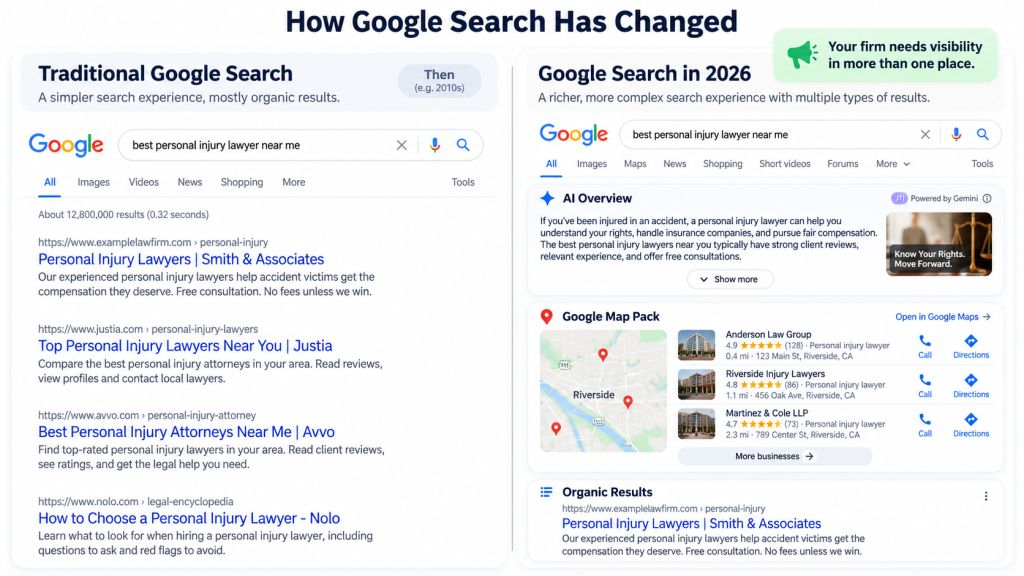
Comparison of traditional Google search results and 2026 search results with AI Overview, Google Map Pack and organic listings.

The Three Surfaces of Law Firm SEO

When someone searches for an attorney today, there are basically three major places your firm can appear.

We call them the Three Surfaces.

Surface 1: The AI AnswerThis is the AI-generated summary Google may display at the top of the page.

Instead of simply giving users a list of websites, Google attempts to answer the question for them.

Your goal is to make your law firm’s content clear, useful, well-structured, and authoritative enough that search engines can understand it and potentially use it as a source.

Surface 2: The Google Map Pack

This is the group of local businesses that appears with a map.

For a local law firm, this is incredibly important.

Someone searching for a divorce attorney, probate lawyer, or estate planning attorney often wants someone nearby.

That means your Google Business Profile, reviews, location, categories, and overall local presence matter.

Surface 3: Traditional Organic Results

These are the familiar website results underneath everything else.

We absolutely do not want to abandon traditional SEO.

Your website still needs strong practice area pages, useful content, good internal linking, legitimate backlinks, sound technical SEO, and local relevance.

The mistake is putting your entire SEO budget into Surface 3 while ignoring the other two.

Your goal should be visibility across all Three Surfaces.

And this is actually good news for smaller law firms.

You may not be able to outspend a giant personal injury firm with a seven-figure marketing budget.

But local search isn’t just about who spends the most money.

A two-attorney firm can still build an extremely strong presence in the county it actually serves.

4 Law Firm SEO Strategies That Actually Matter in 2026

So what should you be working on?

Here are four areas we think deserve your attention.

1. Treat Your Google Business Profile Like a Living Asset

Please do not treat your Google Business Profile like something you set up five years ago and never touched again.

It is one of your most important local marketing assets.

Whitespark’s 2026 Local Search Ranking Factors report surveys local SEO professionals about the factors they believe have the greatest influence on local rankings.

In that survey, Google Business Profile signals remain one of the largest categories influencing local pack visibility.

You can review the full Whitespark 2026 Local Search Ranking Factors report.

And some of the things that matter are surprisingly simple.

Start with your primary business category.

Yes, the dropdown box.

Make sure it actually describes the primary service your firm provides.

Then look at the rest of the profile.

  • Are your services listed?
  • Are your hours accurate?
  • Is your phone number correct?
  • Do you have current photos?
  • Is someone updating the profile regularly?

Before someone talks you into another complicated six-month SEO project, make sure the basics are actually right.

For a deeper look at Google Business Profile, reviews, citations, and local search, read our IFTS guide to getting your law firm found on Google and trusted by clients.

2. Focus on Getting Reviews Consistently

Attorneys sometimes look at a competitor with 300 reviews and think:

“Well, we’re never catching them.”

You don’t necessarily need to.

The better question is whether your firm is consistently generating new reviews.

If you have 75 reviews but haven’t received one in eight months, that sends a very different signal than a firm with 75 reviews that continues receiving new ones every month.

Whitespark’s 2026 survey also points to the growing importance of review signals in local search.

This doesn’t require a complicated marketing campaign.

Finish a matter.

Ask the client for a review.

Make it easy for them to leave one.

Then respond when they do.

The hardest part is usually not knowing what to do. It’s making sure someone at the firm is responsible for doing it every single time.

3. Write Content That Actually Answers the Question

This is one of the biggest changes we would make to a lot of older law firm websites.

Stop trying so hard to sound like a lawyer.

Your potential client probably isn’t searching:

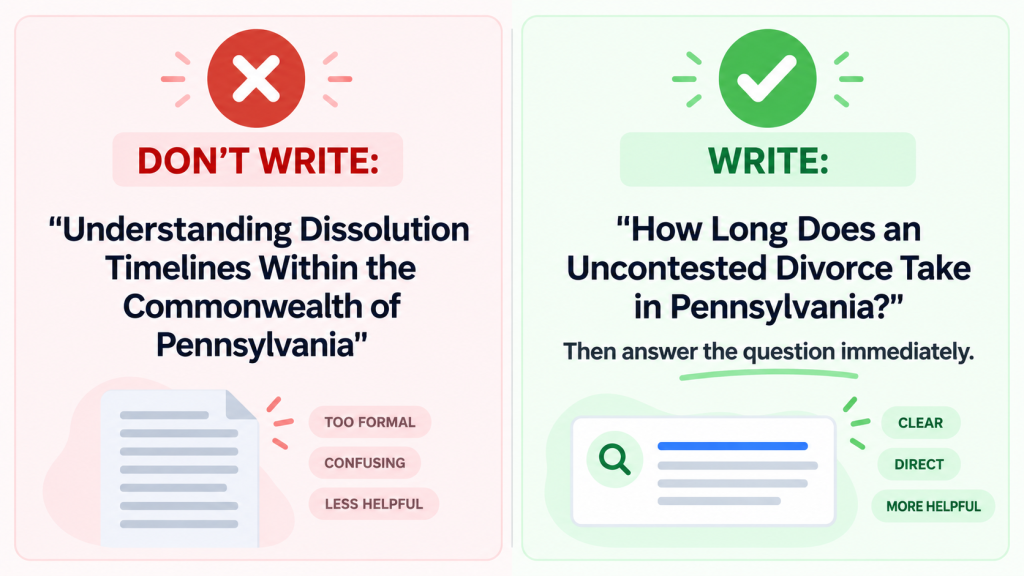
“Understanding Dissolution Timelines Within the Commonwealth of Pennsylvania.”

They’re searching:

“How long does an uncontested divorce take in Pennsylvania?”

Use that as the heading.

Then answer it.

Immediately.

Don’t make someone read five paragraphs about how every legal situation is unique before giving them any useful information.

Give the potential client a clear answer…And give Google a clear answer it can understand.

That becomes even more important as AI systems attempt to extract answers directly from website content.

We go deeper into this in our article on turning your law firm website into a client-generating machine with useful content and video.

Clear content is better for people.

It is also easier for search engines and AI systems to understand.

Example showing how law firms can replace complicated legal-style headings with clear questions potential clients actually search.

4. Build Boring, Legitimate Local Links

Good SEO is not always exciting.

Sometimes the best opportunities are incredibly boring.

  • Your county bar association.
  • Your local chamber of commerce.
  • A community organization you sponsor.
  • A legitimate local event.
  • A scholarship.
  • A nonprofit your firm supports.

Those links may not look impressive on an SEO report.

But they are real.

They are local.

And they actually have something to do with your business.

We would take a smaller number of legitimate, relevant local links over hundreds of mystery backlinks from websites nobody has ever heard of. While you’re at it, make sure your important business listings are accurate too.

Your firm’s name, address, and phone number should be consistent across the places that matter.

Don’t overcomplicate it.

4 SEO Expenses We Would Question

Now let’s flip this around.

If we were reviewing an SEO invoice for a law firm, there are several things that would immediately make us ask questions.

1. Publishing Content Just to Hit a Monthly Quota

More content does not automatically equal better SEO.

If your package includes 12 blogs every month, ask why.

  • Are those 12 articles answering real questions?
  • Are people reading them?
  • Are they supporting your practice area pages?
  • Are they bringing in relevant traffic?
  • Are they helping potential clients?
  • Or is someone publishing 12 articles because the contract says they owe you 12 articles?

We would rather have one genuinely useful page answering a question your clients actually ask than 12 generic articles nobody needs.

2. Treating Domain Authority Like a Business Result

Domain Authority can be a useful third-party metric.

But it is not a metric created or used by Google.

So if the big accomplishment on your SEO report is:

“Your Domain Authority increased from 22 to 28!”

Our next question would be:

Did the phone ring more?

Nobody hires a divorce attorney because they were impressed by the firm’s Domain Authority score.

Use metrics like that as diagnostic tools.

Don’t confuse them with actual business results.

3. Blasting Your Firm Into Hundreds of Directories

Accurate citations still have value.

Your law firm should have correct business information in the places people and search engines actually use.

But that does not mean you need to be submitted to 300 random directories.

Focus on the important listings.

Make sure they are accurate. Keep them accurate.

Then move on to work that has a greater impact.

4. Letting Your Marketing Company Own Your Accounts

This one has nothing to do with Google’s algorithm.

Check who owns your:

  • Domain name
  • Website
  • Google Business Profile
  • Google Analytics account
  • Google Search Console account

Your firm should have access to all of them.

Ideally, your firm should be the actual owner.

Your marketing company should have permission to work inside your accounts.

They should not own your digital presence.

At IFTS, if a client decides to leave us, their Google Business Profile does not suddenly belong to us.

Their analytics do not belong to us.

Their website doesn’t disappear because they stopped paying us.

It is their business.

It should be their property.

Stop Measuring SEO With Rankings Alone

There is one change we would encourage every small law firm to make this month.

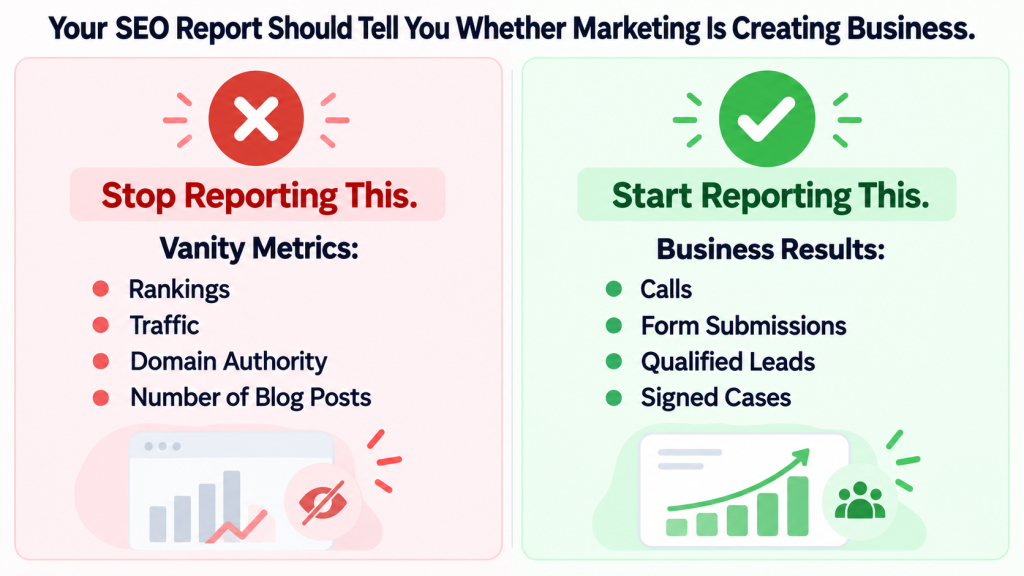
Stop accepting a rankings report as the complete measurement of whether your SEO is working.

We still care about rankings.

We still care about traffic.

Both are useful.

But we also want to know:

  • How many phone calls came from search?
  • How many people requested directions?
  • How many contact forms were submitted?
  • Which pages generated inquiries?
  • How many inquiries were qualified?
  • How many of those prospects actually became clients?

Because the goal of your marketing is not to make a graph go up.

The goal is to help your firm bring in more of the right cases.

That is what your reporting should help you understand.

Comparison of law firm SEO vanity metrics with business metrics including calls, leads and signed cases

Good SEO in 2026 Is Mostly About Consistency

None of the things in this article are magic. You can do most of them yourself.

The challenge is doing them consistently.

  • It’s updating your Google Business Profile again next week.
  • It’s asking the next satisfied client for a review.
  • It’s improving another page next month.
  • It’s earning another legitimate local link.
  • It’s checking whether your calls and leads are actually increasing.

Then doing it again.

And again…While you’re also running a law firm.

That is really what good SEO has become.

Not one secret trick.

Not one giant batch of backlinks.

Not publishing another 50 mediocre blogs.

It is consistently making your law firm stronger across the Three Surfaces where potential clients are actually finding attorneys:

  • AI answers.
  • The Google Map Pack.
  • Traditional organic search.

How Does Your Law Firm Look Across the Three Surfaces?

If you aren’t sure, we can take a look.

IFTS offers a free SEO audit call where we review your Google Business Profile, reviews, website, and current search visibility.

We’ll show you where your firm is already doing well and where you may be missing opportunities.

No complicated lead magnet.

No 37-page automated report that tells you nothing.

Just a conversation about what we see and what we would prioritize.

Schedule Your Free Law Firm SEO Audit: https://iftsdesign.com/get-more-clients 

“Using AI Is Fraud.” A Law Firm Told Me That. Here’s What I Told Them Back.

If you run a family law or estate planning firm with two to ten attorneys, you’ve seen the headlines: judges sanctioning lawyers over the misuse of AI. And somewhere in the back of your head, you may have decided that means AI isn’t for your firm.

I want to show you why that’s the wrong lesson — and I want to start with a conversation that actually happened.

"Using AI is fraud"

A marketing team at a firm we work with told me, flat out: “Using AI is fraud.”

Here’s the thing. This firm prosecutes fraud. So when they say that, they mean it.

And they’re not alone. Read the comments under any of these sanction stories and you’ll find potential clients saying things like, “If I found out my lawyer was using ChatGPT, I’d fire them so fast.”

Where they're right

About legal work? They’re right.

If an AI drafts a brief, nobody checks it, and it goes in front of a judge with made-up cases in it — that deserves sanctions. Someone hiring a lawyer to protect their kids or their freedom does not want a chatbot advising them. Full stop.

So if you’ve been hesitating on AI, that’s not you being behind. That’s your judgment working.

But here’s what the headlines never tell you about what actually happened in those cases.

This is a legal malpractice story, not an AI story

Honestly, when I see these stories, I roll my eyes a little. Not because the sanctions weren’t deserved — they were. It’s because of the lesson everyone takes from them.

Nobody in these cases got sanctioned for using AI. They got sanctioned for signing words they never checked. That’s a proofreading failure wearing an AI costume.

You’d get the same sanction for citing a book you never opened. AI is a book that talks back — you still have to check the citations. The attorneys in the headlines skipped due diligence, and the AI took the headline.

In every one of these cases, the judge’s question is the same: “Where did this come from?” The sanctioned attorneys couldn’t answer it.

I call that the provenance rule: know where every word came from.

And here’s the turn. That exact question — the one that sank the attorneys in the news — is what makes AI marketing safe, if you build your system around answering it.

The Closed Book Method

First, understand what AI actually is, because it’s what the lawyers in the headlines got backwards. AI is not a source of knowledge. It’s a presenter of your knowledge. You confirm the facts. It makes them presentable.

Here’s how we run it at IFTS. We call it the Closed Book Method.

Most people use AI like an open-book exam — except the AI brings its own book, and sometimes the book is made up. Those are the “AI hallucinations” you’ve read about, and they’re exactly where the bogus citations come from.

We run it closed book:

  • We sit your attorneys down on camera — about thirty to sixty minutes each — and interview them about the questions their prospects actually ask.
  • That footage becomes the only book allowed in the room. The AI uses only what the attorney said on camera — nothing from outside it — to draft the blogs, the videos, the website content, all of it.
  • Then a human does the final pass. AI gets you eighty percent of the way; a person finishes the last twenty. Every piece, no exceptions.

If you didn’t say it on camera, the AI can’t say it either. It can’t cite a bogus case, because it was never allowed to go looking for cases. It can only repackage what you said.

So when the provenance question comes, the answer is always the same: From the attorney. On camera. We have the footage.

A real firm, real numbers

I know the theory only goes so far, so here’s a real example.

Bononi & Company is a Pennsylvania firm covering bankruptcy, family law, estate planning, and business law. Thirty minutes of filming per attorney fuels about six months of marketing material for their entire website. Across a year, that’s roughly eight hours of attorney time.

What came out of it:

  • Over 1,500 qualified leads
  • 75,000+ new website visitors
  • Best campaigns at about $49 per lead
  • A top blog post ranking on page one of Google with over 8,000 views
  • Three new attorneys hired to handle the caseload

And here’s the whole story in two sentences: the lawyers in the headlines got sanctioned for filing words they never verified. Bononi doesn’t even have to approve their marketing content — because there isn’t a word in it they didn’t say themselves.

That’s the provenance rule, running in a closed-book environment.

Where we draw our own lines

So you know we hold ourselves to the same standard: our videos that use an AI twin get marked as AI on YouTube, every time. Our 80/20 content doesn’t — because by our own rule, the knowledge is entirely the human’s. Nobody discloses that a paralegal formatted their newsletter. This is the same thing.

Two things you can use today

Before any AI-assisted content publishes at your firm, run the two-question check:

  1. Does it cite anything specific? A law, a stat, a case, a deadline.
  2. If yes — can you find that exact fact in a primary source? Not by asking the AI to confirm itself. A primary source.

Can’t find it? That’s the failure from the headlines, caught before it cost you anything.

And second: name a sign-off owner. One person — even in a three-person firm — owns the final check before anything AI-assisted goes live.

One quick flag while you’re at it: YouTube’s AI labels and your state bar’s advertising rules are two separate tracks. Content you said on camera and approved sits comfortably inside both — but check your state bar’s rules. That’s a one-hour project, not a reason to opt out of AI.

The bottom line

The firms sitting this out because of the headlines are handing an advantage to the firms that built the checks.

The question was never “is AI safe?” It’s the judge’s question: do you know where every word came from?

If your answer is “from the attorney, on camera, and we have the footage” — you will never be the one making the news.

Want to see exactly how this works? The full Bononi & Company case study is right there — no form, no call, no email gate. Just a link, and it works.

The Biggest AI Mistake Law Firms Are Making

Key Takeaway

AI is not replacing Google. People are simply changing how they ask questions, where they search, and how they decide who to trust. The law firms that win in this next era of marketing will be the ones that consistently answer real client questions, create trust-building content, and make that content easy to find across Google, YouTube, LinkedIn, ChatGPT, and other AI search tools.

AI Is Not Replacing Google — Search Behavior Is Changing

One of the biggest mistakes I think law firms are making right now is assuming AI is replacing Google.

I don’t think that’s what’s happening.

I think something much more interesting is happening.

People are not replacing Google. They are changing how they ask questions.

For years, law firm marketing was heavily focused on Google. And for good reason. People searched things like:

“Estate planning attorney near me”

“Probate lawyer in Pittsburgh”

“DUI attorney in Charleston”

Those searches were short, direct, and very keyword-focused.

But now, people are starting to ask questions differently. Instead of typing a few words into Google, someone might open ChatGPT, Perplexity, Gemini, or another AI assistant and ask:

“My parents just moved to South Carolina. What should they think about before updating their estate plan?”

That is the same general need.

But it is a completely different behavior.

And that matters for law firm marketing.

Google is not disappearing. 

In fact, Google itself is adding AI features directly into search results through AI Overviews, which are designed to help people quickly understand more complex topics and explore relevant source links. (Google for Developers) 

ChatGPT has also added search capabilities that can provide timely answers with links to relevant web sources. (OpenAI)

So the real question is not, “Is AI replacing Google?”

The better question is:

Is your law firm creating the kind of helpful, trustworthy content that can be found no matter where someone starts searching?

The Way People Find Attorneys Has Become More Fragmented

Twenty or thirty years ago, someone may have opened the Yellow Pages and chosen the law firm with the biggest or most trustworthy-looking ad.

Then Google became the dominant place people searched.

Today, the client journey is more fragmented.

Someone might discover your law firm through:

  • Google
  • ChatGPT
  • YouTube
  • LinkedIn
  • online directories
  • referrals
  • social media
  • Google Business Profile
  • AI-generated recommendations

These channels are not replacing each other.

They are working together.

That means your legal marketing strategy cannot depend on only one platform. It has to help potential clients discover, understand, and trust your firm in multiple places.

That is the bigger shift.

This is not just about AI.

It is about how people make decisions now.

What AI Search Is Actually Looking For

So naturally, the question becomes:

How does a law firm increase its chances of showing up when someone asks AI a legal question?

Oddly enough, the answer is not nearly as complicated as many people think.

AI systems are looking for many of the same things people are looking for:

  • Helpful information
  • Clear explanations
  • Trustworthy expertise
  • Consistent authority signals
  • Content that directly answers real questions

Think about the questions your clients ask every week.

Things like:

  • Do I need a will or a trust?
  • What happens after a DUI arrest?
  • How long does probate take?
  • How much is inheritance tax?
  • How do I form an LLC?

If your law firm has never answered those questions publicly, AI has very little to work with…so it’s not going to suggest your firm as an answer.

That means one of the simplest things your firm can do is create content around the questions you are already answering every day.

This is not about chasing some mysterious AI algorithm.

It is about becoming more useful.

And honestly, that has always been the foundation of good marketing.

Why Video Matters So Much for Law Firms

If I could recommend one format for creating this kind of content, it would be video.

Here’s why.

People do not just hire attorneys because they are knowledgeable.

They hire attorneys they trust.

A blog can demonstrate your expertise. That matters.

But a video demonstrates your expertise and your personality.

People can hear how you explain things. They can see how you communicate. They get a sense of whether you are calm, clear, confident, and approachable.

That is incredibly important because calling a law firm can be intimidating.

By the time someone finally contacts your office, they may have already:

  • Watched several of your videos
  • Read one of your blog posts
  • Seen your LinkedIn content
  • Visited your website
  • Asked ChatGPT questions about your practice area
  • Checked your reviews

At that point, they are not calling a complete stranger anymore.

They already feel like they know you a little bit.

That is a huge advantage.

And that is why video marketing for law firms is becoming so important. Video builds trust before the first phone call ever happens.

One Video Can Create Multiple Discovery Paths

Here’s what I love about video.

You do not create it for one platform.

One video can become:

  • A YouTube video
  • A blog article
  • A LinkedIn article
  • Several LinkedIn posts
  • Short social media clips
  • Google Business Profile updates
  • Email newsletter content
  • Content that AI systems can better understand

One piece of content.

Multiple discovery paths.

This is where a lot of law firms are leaving opportunities on the table.

They think content creation means constantly creating something brand new.

It does not have to.

If you answer one common client question on video, that one answer can fuel your marketing for weeks.

That is how you save time and money.

You are not creating more work.

You are getting more value from work you already did.

This is also why content repurposing is so important. Your future clients are not all looking in the same place. Some are on Google. Some are on YouTube. Some are on LinkedIn. Some are asking AI tools. Some are asking friends and referral sources.

The more places your helpful content appears, the more likely it is that your expertise will be discovered.

.

Create Trust Once. Distribute It Everywhere.

This is really the heart of modern legal marketing.

It is not about chasing the newest platform.

It is not about trying to outsmart the next algorithm.

It is about creating content that genuinely helps people, builds trust, and then making sure that trust can be discovered wherever someone happens to be looking.

Create trust once.

Distribute it everywhere.

That is the shift.

And it is much more sustainable than trying to create separate content strategies for Google, YouTube, LinkedIn, ChatGPT, and every other platform.

Quick Win: Write Down the Last Five Questions Clients Asked You

Here is one thing you can do today.

Grab a piece of paper and write down the last five questions a client asked you.

That’s it.

Those five questions can become your next:

  • Five blog posts
  • Five YouTube videos
  • Five LinkedIn articles
  • Five email topics
  • Five social media posts
  • Five opportunities for someone – or even AI – to discover your expertise

Want to go one step further?

Set up your phone, sit at your desk, and answer each question simply and clearly.

You do not need a full production studio.

You do not need a perfect script.

You just need to answer the question in a way a potential client would understand.

That simple exercise can give your firm a month’s worth of content.

And the best part is, you are not guessing at topics.

You are using real questions from real clients.

That is exactly the type of content people are already searching for.

Need a little more help with this? Check out this article from IFTS on how exactly to create YouTube videos: https://blog.iftsdesign.com/how-law-firms-can-get-more-clients-from-youtube-without-filming-every-week-or-at-all/ 

Stop Optimizing for Platforms. Start Optimizing for Being the Best Answer.

I do not think law firms should spend all of their time trying to optimize for Google.

Or ChatGPT.

Or YouTube.

Or LinkedIn.

Instead, optimize for being the best answer.

Because helpful content works everywhere.

  • It works in Google.
  • It works in ChatGPT.
  • It works on YouTube.
  • It works on LinkedIn.
  • It works for referrals.

If your content clearly answers real questions, builds trust, and demonstrates your expertise, it becomes useful across multiple channels.

That is the real advantage.

The firms that consistently publish useful, trustworthy information are going to be easier to find no matter how search changes.

And search will continue to change.

The question is whether your law firm’s expertise will be easy to discover when it does.

The Bottom Line for Law Firm Marketing in the AI Era

The biggest AI mistake law firms are making is thinking this is only about AI.

It is not.

It is about consumer behavior.

People are asking better questions. They are using more platforms. They are researching longer before they contact a law firm. They are looking for expertise, but they are also looking for trust.

That means your law firm marketing needs to do more than rank.

It needs to educate.

It needs to build confidence.

It needs to make your expertise discoverable across the places people are already looking.

The firms that win over the next decade will not necessarily be the firms with the biggest budgets.

They will be the firms that consistently create helpful content, build trust before the first conversation, and distribute that trust everywhere.

Want Help Building This Kind of System?

At IFTS, we help law firms create educational content once and distribute it across multiple platforms, including YouTube, websites, LinkedIn, Google Business Profile, email, social media, and AI search.

Our Law Firm Kickstarter Kit is designed to help attorneys build trust and visibility without spending hours every week creating new content.  Check it out here: https://iftsdesign.com/kickstarter-kit