
Lawyer SEO in 2026: What Actually Moves the Needle (And What’s a Waste of Money)

Your law firm can still be ranking well on Google and getting less website traffic than it used to.

Those two things sound like they shouldn’t happen at the same time.

But they absolutely can.

And if you’re paying an SEO company every month, this is something they should be talking to you about.

SEO has changed.

That doesn’t mean traditional rankings no longer matter. They do.

But rankings are only one piece of the picture now.

For smaller family law, estate planning, probate, and other local law firms, the goal in 2026 shouldn’t simply be “rank higher on Google.”

The goal should be to make sure potential clients can find your firm everywhere Google is showing answers.

We think about that in terms of what we call the Three Surfaces of SEO.

Before we get into those, though, we need to talk about what changed.

Why Your Google Rankings Can Be Up While Your Traffic Is Down

For years, SEO was pretty straightforward. The higher your website ranked in Google, the more likely someone was to click on it.

So SEO companies focused heavily on keyword rankings. If your firm moved from position eight to position four, that was progress. If you moved from four to two, even better.

That still matters.

But people don’t interact with Google the same way they did a few years ago.

Google now frequently displays AI-generated answers above the traditional search results.

And those answers are changing what people click.

A Pew Research Center study analyzed nearly 69,000 Google searches performed by 900 U.S. adults.

When an AI summary appeared, users clicked a traditional search result about 8% of the time.

When there was no AI summary, that number was about 15%.

Even more interesting: users clicked one of the links contained inside the AI summary itself only about 1% of the time.

You can read the full Pew Research Center study on Google AI summaries and click behavior.

This matters especially for attorneys because of the kinds of searches potential clients make.

They don’t always search:

“divorce lawyer Pittsburgh”

They also search:

“How long does probate take in Pennsylvania?”

“What happens to the house during a divorce?”

“Do I need a will if I already have a trust?”

Pew found that searches beginning with question words such as “what,” “who,” “when,” and “why” generated an AI summary about 60% of the time.

In other words, exactly the kind of educational content law firms have spent years creating is also the kind of content Google may now summarize directly on the search page.

Your ranking may not have changed.

But the number of people who need to click your website can.

That’s why we need to look at SEO differently.

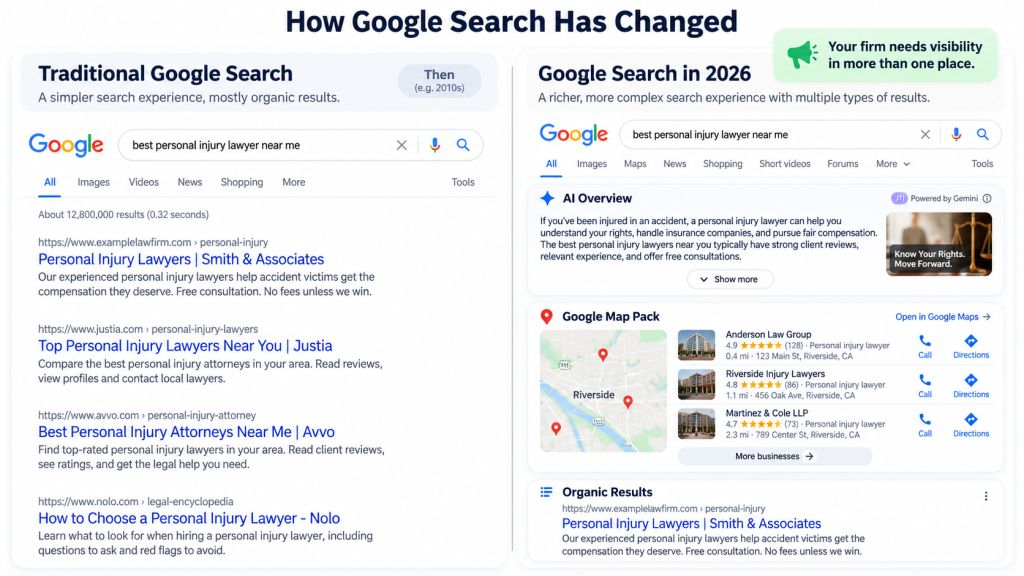
Comparison of traditional Google search results and 2026 search results with AI Overview, Google Map Pack and organic listings.

The Three Surfaces of Law Firm SEO

When someone searches for an attorney today, there are basically three major places your firm can appear.

We call them the Three Surfaces.

Surface 1: The AI AnswerThis is the AI-generated summary Google may display at the top of the page.

Instead of simply giving users a list of websites, Google attempts to answer the question for them.

Your goal is to make your law firm’s content clear, useful, well-structured, and authoritative enough that search engines can understand it and potentially use it as a source.

Surface 2: The Google Map Pack

This is the group of local businesses that appears with a map.

For a local law firm, this is incredibly important.

Someone searching for a divorce attorney, probate lawyer, or estate planning attorney often wants someone nearby.

That means your Google Business Profile, reviews, location, categories, and overall local presence matter.

Surface 3: Traditional Organic Results

These are the familiar website results underneath everything else.

We absolutely do not want to abandon traditional SEO.

Your website still needs strong practice area pages, useful content, good internal linking, legitimate backlinks, sound technical SEO, and local relevance.

The mistake is putting your entire SEO budget into Surface 3 while ignoring the other two.

Your goal should be visibility across all Three Surfaces.

And this is actually good news for smaller law firms.

You may not be able to outspend a giant personal injury firm with a seven-figure marketing budget.

But local search isn’t just about who spends the most money.

A two-attorney firm can still build an extremely strong presence in the county it actually serves.

4 Law Firm SEO Strategies That Actually Matter in 2026

So what should you be working on?

Here are four areas we think deserve your attention.

1. Treat Your Google Business Profile Like a Living Asset

Please do not treat your Google Business Profile like something you set up five years ago and never touched again.

It is one of your most important local marketing assets.

Whitespark’s 2026 Local Search Ranking Factors report surveys local SEO professionals about the factors they believe have the greatest influence on local rankings.

In that survey, Google Business Profile signals remain one of the largest categories influencing local pack visibility.

You can review the full Whitespark 2026 Local Search Ranking Factors report.

And some of the things that matter are surprisingly simple.

Start with your primary business category.

Yes, the dropdown box.

Make sure it actually describes the primary service your firm provides.

Then look at the rest of the profile.

  • Are your services listed?
  • Are your hours accurate?
  • Is your phone number correct?
  • Do you have current photos?
  • Is someone updating the profile regularly?

Before someone talks you into another complicated six-month SEO project, make sure the basics are actually right.

For a deeper look at Google Business Profile, reviews, citations, and local search, read our IFTS guide to getting your law firm found on Google and trusted by clients.

2. Focus on Getting Reviews Consistently

Attorneys sometimes look at a competitor with 300 reviews and think:

“Well, we’re never catching them.”

You don’t necessarily need to.

The better question is whether your firm is consistently generating new reviews.

If you have 75 reviews but haven’t received one in eight months, that sends a very different signal than a firm with 75 reviews that continues receiving new ones every month.

Whitespark’s 2026 survey also points to the growing importance of review signals in local search.

This doesn’t require a complicated marketing campaign.

Finish a matter.

Ask the client for a review.

Make it easy for them to leave one.

Then respond when they do.

The hardest part is usually not knowing what to do. It’s making sure someone at the firm is responsible for doing it every single time.

3. Write Content That Actually Answers the Question

This is one of the biggest changes we would make to a lot of older law firm websites.

Stop trying so hard to sound like a lawyer.

Your potential client probably isn’t searching:

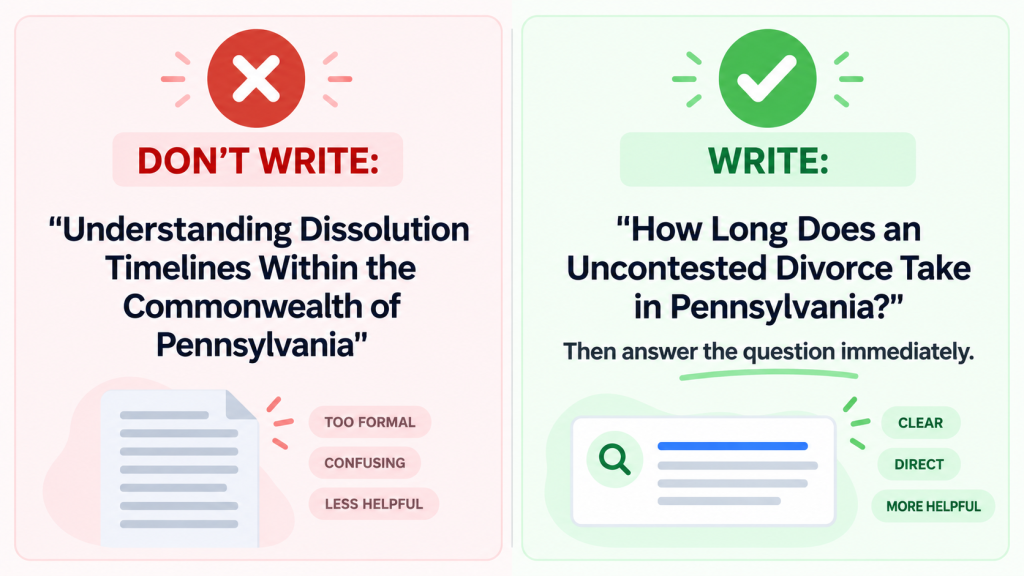
“Understanding Dissolution Timelines Within the Commonwealth of Pennsylvania.”

They’re searching:

“How long does an uncontested divorce take in Pennsylvania?”

Use that as the heading.

Then answer it.

Immediately.

Don’t make someone read five paragraphs about how every legal situation is unique before giving them any useful information.

Give the potential client a clear answer…And give Google a clear answer it can understand.

That becomes even more important as AI systems attempt to extract answers directly from website content.

We go deeper into this in our article on turning your law firm website into a client-generating machine with useful content and video.

Clear content is better for people.

It is also easier for search engines and AI systems to understand.

Example showing how law firms can replace complicated legal-style headings with clear questions potential clients actually search.

4. Build Boring, Legitimate Local Links

Good SEO is not always exciting.

Sometimes the best opportunities are incredibly boring.

  • Your county bar association.
  • Your local chamber of commerce.
  • A community organization you sponsor.
  • A legitimate local event.
  • A scholarship.
  • A nonprofit your firm supports.

Those links may not look impressive on an SEO report.

But they are real.

They are local.

And they actually have something to do with your business.

We would take a smaller number of legitimate, relevant local links over hundreds of mystery backlinks from websites nobody has ever heard of. While you’re at it, make sure your important business listings are accurate too.

Your firm’s name, address, and phone number should be consistent across the places that matter.

Don’t overcomplicate it.

4 SEO Expenses We Would Question

Now let’s flip this around.

If we were reviewing an SEO invoice for a law firm, there are several things that would immediately make us ask questions.

1. Publishing Content Just to Hit a Monthly Quota

More content does not automatically equal better SEO.

If your package includes 12 blogs every month, ask why.

  • Are those 12 articles answering real questions?
  • Are people reading them?
  • Are they supporting your practice area pages?
  • Are they bringing in relevant traffic?
  • Are they helping potential clients?
  • Or is someone publishing 12 articles because the contract says they owe you 12 articles?

We would rather have one genuinely useful page answering a question your clients actually ask than 12 generic articles nobody needs.

2. Treating Domain Authority Like a Business Result

Domain Authority can be a useful third-party metric.

But it is not a metric created or used by Google.

So if the big accomplishment on your SEO report is:

“Your Domain Authority increased from 22 to 28!”

Our next question would be:

Did the phone ring more?

Nobody hires a divorce attorney because they were impressed by the firm’s Domain Authority score.

Use metrics like that as diagnostic tools.

Don’t confuse them with actual business results.

3. Blasting Your Firm Into Hundreds of Directories

Accurate citations still have value.

Your law firm should have correct business information in the places people and search engines actually use.

But that does not mean you need to be submitted to 300 random directories.

Focus on the important listings.

Make sure they are accurate. Keep them accurate.

Then move on to work that has a greater impact.

4. Letting Your Marketing Company Own Your Accounts

This one has nothing to do with Google’s algorithm.

Check who owns your:

  • Domain name
  • Website
  • Google Business Profile
  • Google Analytics account
  • Google Search Console account

Your firm should have access to all of them.

Ideally, your firm should be the actual owner.

Your marketing company should have permission to work inside your accounts.

They should not own your digital presence.

At IFTS, if a client decides to leave us, their Google Business Profile does not suddenly belong to us.

Their analytics do not belong to us.

Their website doesn’t disappear because they stopped paying us.

It is their business.

It should be their property.

Stop Measuring SEO With Rankings Alone

There is one change we would encourage every small law firm to make this month.

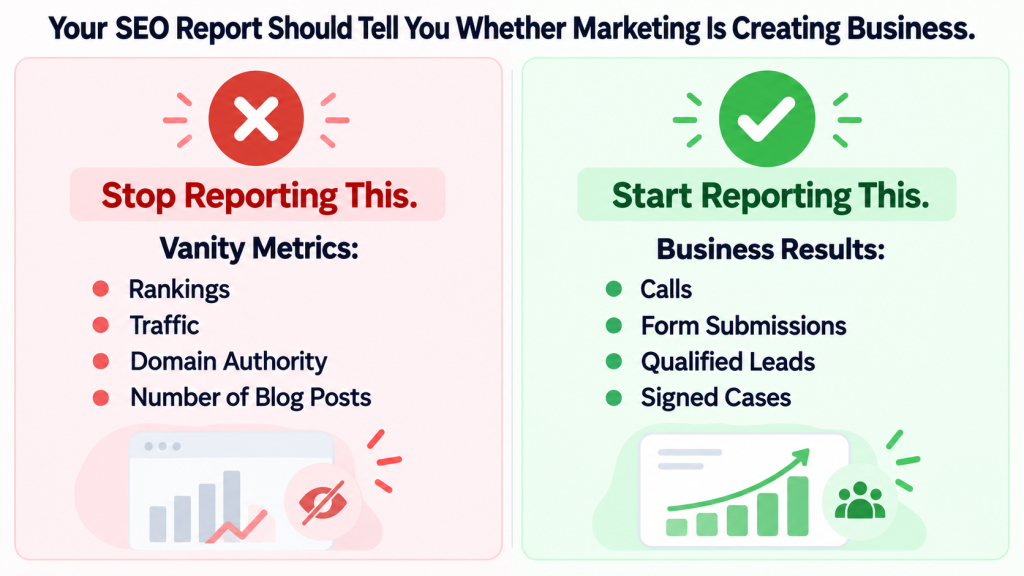
Stop accepting a rankings report as the complete measurement of whether your SEO is working.

We still care about rankings.

We still care about traffic.

Both are useful.

But we also want to know:

  • How many phone calls came from search?
  • How many people requested directions?
  • How many contact forms were submitted?
  • Which pages generated inquiries?
  • How many inquiries were qualified?
  • How many of those prospects actually became clients?

Because the goal of your marketing is not to make a graph go up.

The goal is to help your firm bring in more of the right cases.

That is what your reporting should help you understand.

Comparison of law firm SEO vanity metrics with business metrics including calls, leads and signed cases

Good SEO in 2026 Is Mostly About Consistency

None of the things in this article are magic. You can do most of them yourself.

The challenge is doing them consistently.

  • It’s updating your Google Business Profile again next week.
  • It’s asking the next satisfied client for a review.
  • It’s improving another page next month.
  • It’s earning another legitimate local link.
  • It’s checking whether your calls and leads are actually increasing.

Then doing it again.

And again…While you’re also running a law firm.

That is really what good SEO has become.

Not one secret trick.

Not one giant batch of backlinks.

Not publishing another 50 mediocre blogs.

It is consistently making your law firm stronger across the Three Surfaces where potential clients are actually finding attorneys:

  • AI answers.
  • The Google Map Pack.
  • Traditional organic search.

How Does Your Law Firm Look Across the Three Surfaces?

If you aren’t sure, we can take a look.

IFTS offers a free SEO audit call where we review your Google Business Profile, reviews, website, and current search visibility.

We’ll show you where your firm is already doing well and where you may be missing opportunities.

No complicated lead magnet.

No 37-page automated report that tells you nothing.

Just a conversation about what we see and what we would prioritize.

Schedule Your Free Law Firm SEO Audit: https://iftsdesign.com/get-more-clients