
Law Firm Video Retargeting: Bring Website Visitors Back

How Law Firms Can Use Video Retargeting to Bring Website Visitors Back

Someone visits your law firm’s website. They read your divorce page or your estate planning page. Maybe they even look at your attorney bio.

And then they leave.

That doesn’t necessarily mean they chose another firm. They may have been interrupted, needed to speak with a family member, or simply not been ready to contact an attorney yet.

But if you never reach them again, you’re relying on that person to remember your firm when they are ready.

This is one of the biggest opportunities we see small law firms overlooking. You may already be getting interested people to your website. The question is what happens after they leave.

Start With One Question Your Attorney Already Answers

Let’s say you’re an estate planning attorney. You record a three-minute answer to a question you hear all the time: “Do I need a trust, or is a will enough?”

You could upload the video to YouTube and hope someone finds it. That’s a start. But you’ve already put your time and expertise into the answer. 

Why use it only once?

At IFTS, we would also turn that answer into a blog post, embed the video on a relevant page of your website, and pull out a shorter clip for social media. Someone researching wills and trusts now has several ways to encounter your explanation. They can read it, watch it, or come across a short excerpt while scrolling.

That’s the organic side of the strategy. It gives your answer more than one place to live and more than one chance to be useful. We walk through other ways to use a single recording in our article on turning YouTube videos into law firm leads.

But what about someone who has already visited your website and left without calling?

What Is Video Retargeting for a Law Firm?

Retargeting is a way to show ads to an eligible audience of people who previously interacted with your website or content. Google’s explanation of audience segments, for example, includes past website visitors and people who have interacted with a business on Google or YouTube.

Instead of showing those people another generic “Call us today” ad, you could show them a short video of an attorney answering a helpful question.

Imagine someone visited your estate planning page but wasn’t ready to book. Later, they encounter your attorney explaining what factors to consider when deciding between a will and a trust. They’ve seen your firm’s name before. Now they can hear how you explain an issue they’re researching.

Depending on the campaign setup and audience eligibility, a firm may be able to use video to reconnect with interested people across YouTube, other Google ad placements, Facebook, and Instagram. Each platform has its own setup and rules, so this takes more thought than uploading the same ad everywhere.

The goal is to offer another useful interaction with your firm while someone is making a decision.

Because this is legal marketing, privacy and wording matter. A video ad should answer a general question without assuming or announcing anything about a viewer’s personal legal situation. The firm should also review its ads against the applicable platform policies and state attorney advertising rules.

Why Show an Attorney Video Instead of Another Generic Ad?

Think of someone comparing three law firms. Each firm has a professional website. Each might also run an ad asking the person to schedule a consultation.

Now imagine one attorney appears on video and explains what happens during the first meeting. The person can hear the attorney’s voice and get a sense of how they communicate. If the answer helps, that person has a reason to return to the website when they’re ready to take the next step.

That’s why we don’t look at attorney videos as a way to collect views. We want the right people to see a useful answer and feel more comfortable contacting the firm.

The video also needs a clear next step. After watching, someone should be able to reach a relevant practice area page, learn about the consultation process, or contact the firm easily. Our article on turning YouTube views into actual clients explains why that path matters.

How IFTS Used Video as Part of a Larger Law Firm Marketing System

We used this approach as part of a broader marketing system for Bononi & Company, a Pennsylvania law firm.

Their attorneys answered common legal questions on video. We turned those answers into blog posts, shared them on social media, placed them on YouTube, and used videos in retargeting ads.

Across the broader digital campaigns, we tracked more than 1,530 calls and contact form submissions. Their YouTube videos received more than 17,000 views. Those results are from the combined marketing system; they aren’t results we can attribute to retargeting alone.

That’s why this example matters to us. Search and ads helped people find the firm. Blog posts and videos answered their questions. Retargeting provided another opportunity for interested people to see the attorneys before deciding whether to reach out.

No single video or ad gets all the credit. The strategy is in connecting the pieces.

How to Choose Your First Retargeting Video Topic

If your firm already gets website visitors, ask yourself:

What would those visitors benefit from hearing from us before they decide to call?

The answer might be:

  • “What happens at our first consultation?”
  • “How long does probate usually take?”
  • “What affects the cost of a divorce?”

Choose a question that matters to the clients you want to serve and that you can answer clearly without knowing the details of a particular case.

Then use the answer in more than one place: on your website, in a related blog post, in shorter social clips, and, where appropriate, in a thoughtful retargeting campaign. If you need a framework for planning the topics and measuring the results, see our video content strategy guide for law firms.

Make More of the Website Traffic You Already Have

Putting this together takes time. You need to choose topics, edit the recordings, add captions, create blog posts and clips, set up eligible ad audiences, and track whether people actually contact the firm.

That’s the work we handle at Integrity First Technology Solutions. Our process can turn four short attorney answers each month into YouTube videos, blog posts, short clips, and content for organic and paid distribution – with 30 minutes or less of your time per month.

You already have the expertise. You’re already answering these questions. We help those answers reach people who are considering your firm, including visitors who weren’t ready to call the first time they saw your website.

Want to see how that could work for your law firm? Book a call with IFTS.

“Using AI Is Fraud.” A Law Firm Told Me That. Here’s What I Told Them Back.

If you run a family law or estate planning firm with two to ten attorneys, you’ve seen the headlines: judges sanctioning lawyers over the misuse of AI. And somewhere in the back of your head, you may have decided that means AI isn’t for your firm.

I want to show you why that’s the wrong lesson — and I want to start with a conversation that actually happened.

"Using AI is fraud"

A marketing team at a firm we work with told me, flat out: “Using AI is fraud.”

Here’s the thing. This firm prosecutes fraud. So when they say that, they mean it.

And they’re not alone. Read the comments under any of these sanction stories and you’ll find potential clients saying things like, “If I found out my lawyer was using ChatGPT, I’d fire them so fast.”

Where they're right

About legal work? They’re right.

If an AI drafts a brief, nobody checks it, and it goes in front of a judge with made-up cases in it — that deserves sanctions. Someone hiring a lawyer to protect their kids or their freedom does not want a chatbot advising them. Full stop.

So if you’ve been hesitating on AI, that’s not you being behind. That’s your judgment working.

But here’s what the headlines never tell you about what actually happened in those cases.

This is a legal malpractice story, not an AI story

Honestly, when I see these stories, I roll my eyes a little. Not because the sanctions weren’t deserved — they were. It’s because of the lesson everyone takes from them.

Nobody in these cases got sanctioned for using AI. They got sanctioned for signing words they never checked. That’s a proofreading failure wearing an AI costume.

You’d get the same sanction for citing a book you never opened. AI is a book that talks back — you still have to check the citations. The attorneys in the headlines skipped due diligence, and the AI took the headline.

In every one of these cases, the judge’s question is the same: “Where did this come from?” The sanctioned attorneys couldn’t answer it.

I call that the provenance rule: know where every word came from.

And here’s the turn. That exact question — the one that sank the attorneys in the news — is what makes AI marketing safe, if you build your system around answering it.

The Closed Book Method

First, understand what AI actually is, because it’s what the lawyers in the headlines got backwards. AI is not a source of knowledge. It’s a presenter of your knowledge. You confirm the facts. It makes them presentable.

Here’s how we run it at IFTS. We call it the Closed Book Method.

Most people use AI like an open-book exam — except the AI brings its own book, and sometimes the book is made up. Those are the “AI hallucinations” you’ve read about, and they’re exactly where the bogus citations come from.

We run it closed book:

  • We sit your attorneys down on camera — about thirty to sixty minutes each — and interview them about the questions their prospects actually ask.
  • That footage becomes the only book allowed in the room. The AI uses only what the attorney said on camera — nothing from outside it — to draft the blogs, the videos, the website content, all of it.
  • Then a human does the final pass. AI gets you eighty percent of the way; a person finishes the last twenty. Every piece, no exceptions.

If you didn’t say it on camera, the AI can’t say it either. It can’t cite a bogus case, because it was never allowed to go looking for cases. It can only repackage what you said.

So when the provenance question comes, the answer is always the same: From the attorney. On camera. We have the footage.

A real firm, real numbers

I know the theory only goes so far, so here’s a real example.

Bononi & Company is a Pennsylvania firm covering bankruptcy, family law, estate planning, and business law. Thirty minutes of filming per attorney fuels about six months of marketing material for their entire website. Across a year, that’s roughly eight hours of attorney time.

What came out of it:

  • Over 1,500 qualified leads
  • 75,000+ new website visitors
  • Best campaigns at about $49 per lead
  • A top blog post ranking on page one of Google with over 8,000 views
  • Three new attorneys hired to handle the caseload

And here’s the whole story in two sentences: the lawyers in the headlines got sanctioned for filing words they never verified. Bononi doesn’t even have to approve their marketing content — because there isn’t a word in it they didn’t say themselves.

That’s the provenance rule, running in a closed-book environment.

Where we draw our own lines

So you know we hold ourselves to the same standard: our videos that use an AI twin get marked as AI on YouTube, every time. Our 80/20 content doesn’t — because by our own rule, the knowledge is entirely the human’s. Nobody discloses that a paralegal formatted their newsletter. This is the same thing.

Two things you can use today

Before any AI-assisted content publishes at your firm, run the two-question check:

  1. Does it cite anything specific? A law, a stat, a case, a deadline.
  2. If yes — can you find that exact fact in a primary source? Not by asking the AI to confirm itself. A primary source.

Can’t find it? That’s the failure from the headlines, caught before it cost you anything.

And second: name a sign-off owner. One person — even in a three-person firm — owns the final check before anything AI-assisted goes live.

One quick flag while you’re at it: YouTube’s AI labels and your state bar’s advertising rules are two separate tracks. Content you said on camera and approved sits comfortably inside both — but check your state bar’s rules. That’s a one-hour project, not a reason to opt out of AI.

The bottom line

The firms sitting this out because of the headlines are handing an advantage to the firms that built the checks.

The question was never “is AI safe?” It’s the judge’s question: do you know where every word came from?

If your answer is “from the attorney, on camera, and we have the footage” — you will never be the one making the news.

Want to see exactly how this works? The full Bononi & Company case study is right there — no form, no call, no email gate. Just a link, and it works.

The Biggest AI Mistake Law Firms Are Making

Key Takeaway

AI is not replacing Google. People are simply changing how they ask questions, where they search, and how they decide who to trust. The law firms that win in this next era of marketing will be the ones that consistently answer real client questions, create trust-building content, and make that content easy to find across Google, YouTube, LinkedIn, ChatGPT, and other AI search tools.

AI Is Not Replacing Google — Search Behavior Is Changing

One of the biggest mistakes I think law firms are making right now is assuming AI is replacing Google.

I don’t think that’s what’s happening.

I think something much more interesting is happening.

People are not replacing Google. They are changing how they ask questions.

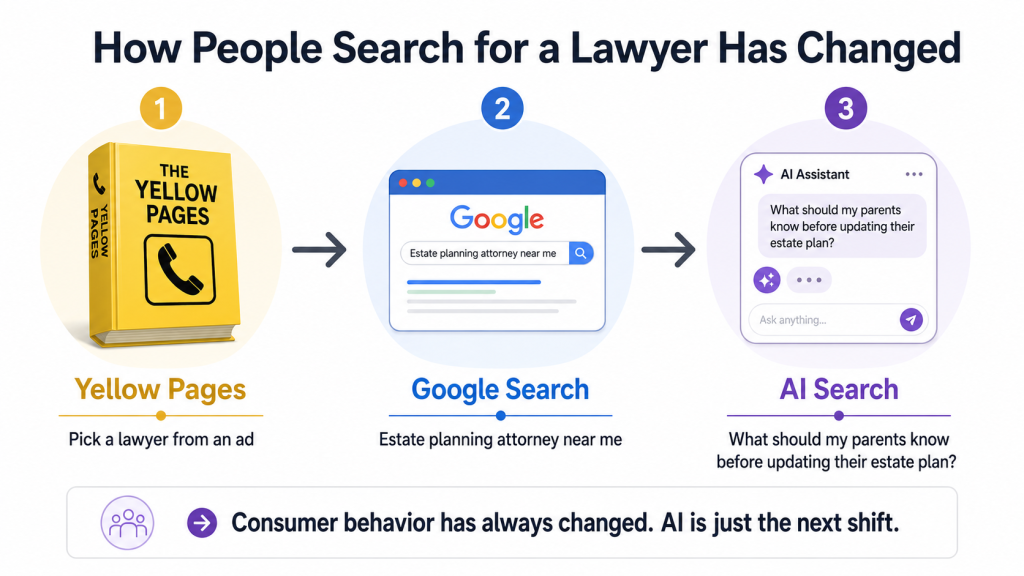
For years, law firm marketing was heavily focused on Google. And for good reason. People searched things like:

“Estate planning attorney near me”

“Probate lawyer in Pittsburgh”

“DUI attorney in Charleston”

Those searches were short, direct, and very keyword-focused.

But now, people are starting to ask questions differently. Instead of typing a few words into Google, someone might open ChatGPT, Perplexity, Gemini, or another AI assistant and ask:

“My parents just moved to South Carolina. What should they think about before updating their estate plan?”

That is the same general need.

But it is a completely different behavior.

And that matters for law firm marketing.

Google is not disappearing. 

In fact, Google itself is adding AI features directly into search results through AI Overviews, which are designed to help people quickly understand more complex topics and explore relevant source links. (Google for Developers) 

ChatGPT has also added search capabilities that can provide timely answers with links to relevant web sources. (OpenAI)

So the real question is not, “Is AI replacing Google?”

The better question is:

Is your law firm creating the kind of helpful, trustworthy content that can be found no matter where someone starts searching?

The Way People Find Attorneys Has Become More Fragmented

Twenty or thirty years ago, someone may have opened the Yellow Pages and chosen the law firm with the biggest or most trustworthy-looking ad.

Then Google became the dominant place people searched.

Today, the client journey is more fragmented.

Someone might discover your law firm through:

  • Google
  • ChatGPT
  • YouTube
  • LinkedIn
  • online directories
  • referrals
  • social media
  • Google Business Profile
  • AI-generated recommendations

These channels are not replacing each other.

They are working together.

That means your legal marketing strategy cannot depend on only one platform. It has to help potential clients discover, understand, and trust your firm in multiple places.

That is the bigger shift.

This is not just about AI.

It is about how people make decisions now.

What AI Search Is Actually Looking For

So naturally, the question becomes:

How does a law firm increase its chances of showing up when someone asks AI a legal question?

Oddly enough, the answer is not nearly as complicated as many people think.

AI systems are looking for many of the same things people are looking for:

  • Helpful information
  • Clear explanations
  • Trustworthy expertise
  • Consistent authority signals
  • Content that directly answers real questions

Think about the questions your clients ask every week.

Things like:

  • Do I need a will or a trust?
  • What happens after a DUI arrest?
  • How long does probate take?
  • How much is inheritance tax?
  • How do I form an LLC?

If your law firm has never answered those questions publicly, AI has very little to work with…so it’s not going to suggest your firm as an answer.

That means one of the simplest things your firm can do is create content around the questions you are already answering every day.

This is not about chasing some mysterious AI algorithm.

It is about becoming more useful.

And honestly, that has always been the foundation of good marketing.

Why Video Matters So Much for Law Firms

If I could recommend one format for creating this kind of content, it would be video.

Here’s why.

People do not just hire attorneys because they are knowledgeable.

They hire attorneys they trust.

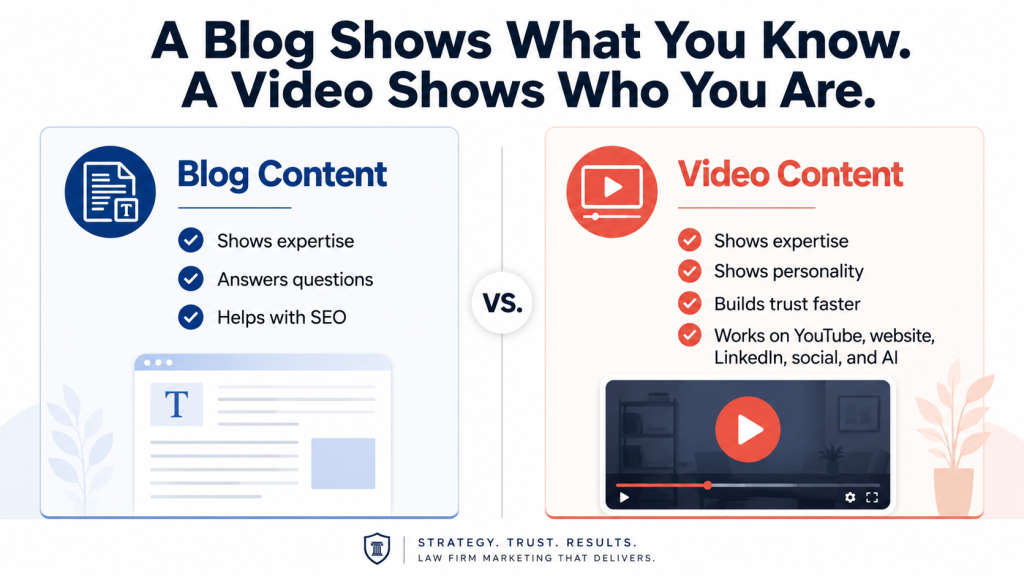
A blog can demonstrate your expertise. That matters.

But a video demonstrates your expertise and your personality.

People can hear how you explain things. They can see how you communicate. They get a sense of whether you are calm, clear, confident, and approachable.

That is incredibly important because calling a law firm can be intimidating.

By the time someone finally contacts your office, they may have already:

  • Watched several of your videos
  • Read one of your blog posts
  • Seen your LinkedIn content
  • Visited your website
  • Asked ChatGPT questions about your practice area
  • Checked your reviews

At that point, they are not calling a complete stranger anymore.

They already feel like they know you a little bit.

That is a huge advantage.

And that is why video marketing for law firms is becoming so important. Video builds trust before the first phone call ever happens.

One Video Can Create Multiple Discovery Paths

Here’s what I love about video.

You do not create it for one platform.

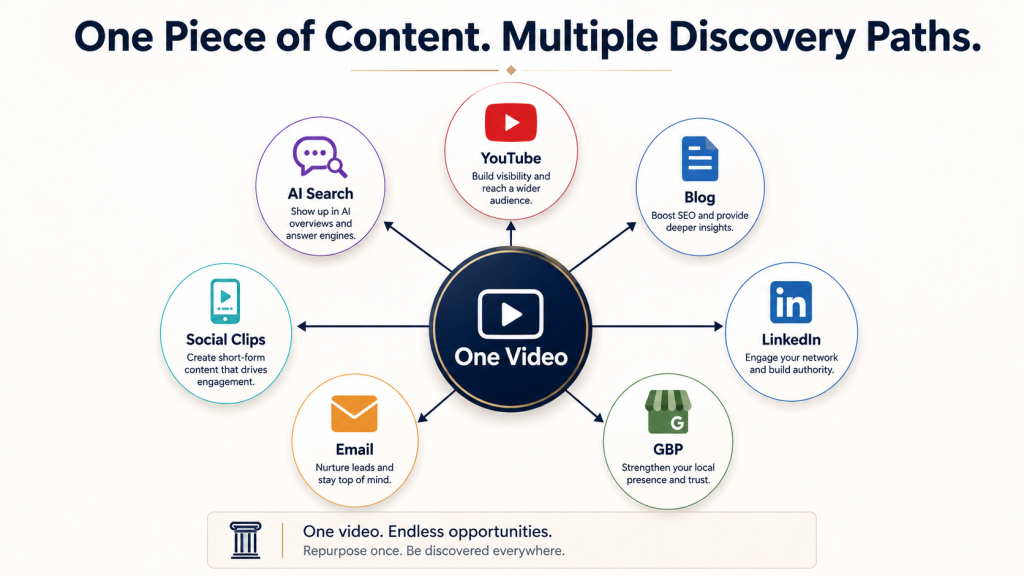
One video can become:

  • A YouTube video
  • A blog article
  • A LinkedIn article
  • Several LinkedIn posts
  • Short social media clips
  • Google Business Profile updates
  • Email newsletter content
  • Content that AI systems can better understand

One piece of content.

Multiple discovery paths.

This is where a lot of law firms are leaving opportunities on the table.

They think content creation means constantly creating something brand new.

It does not have to.

If you answer one common client question on video, that one answer can fuel your marketing for weeks.

That is how you save time and money.

You are not creating more work.

You are getting more value from work you already did.

This is also why content repurposing is so important. Your future clients are not all looking in the same place. Some are on Google. Some are on YouTube. Some are on LinkedIn. Some are asking AI tools. Some are asking friends and referral sources.

The more places your helpful content appears, the more likely it is that your expertise will be discovered.

.

Create Trust Once. Distribute It Everywhere.

This is really the heart of modern legal marketing.

It is not about chasing the newest platform.

It is not about trying to outsmart the next algorithm.

It is about creating content that genuinely helps people, builds trust, and then making sure that trust can be discovered wherever someone happens to be looking.

Create trust once.

Distribute it everywhere.

That is the shift.

And it is much more sustainable than trying to create separate content strategies for Google, YouTube, LinkedIn, ChatGPT, and every other platform.

Quick Win: Write Down the Last Five Questions Clients Asked You

Here is one thing you can do today.

Grab a piece of paper and write down the last five questions a client asked you.

That’s it.

Those five questions can become your next:

  • Five blog posts
  • Five YouTube videos
  • Five LinkedIn articles
  • Five email topics
  • Five social media posts
  • Five opportunities for someone – or even AI – to discover your expertise

Want to go one step further?

Set up your phone, sit at your desk, and answer each question simply and clearly.

You do not need a full production studio.

You do not need a perfect script.

You just need to answer the question in a way a potential client would understand.

That simple exercise can give your firm a month’s worth of content.

And the best part is, you are not guessing at topics.

You are using real questions from real clients.

That is exactly the type of content people are already searching for.

Need a little more help with this? Check out this article from IFTS on how exactly to create YouTube videos: https://blog.iftsdesign.com/how-law-firms-can-get-more-clients-from-youtube-without-filming-every-week-or-at-all/ 

Stop Optimizing for Platforms. Start Optimizing for Being the Best Answer.

I do not think law firms should spend all of their time trying to optimize for Google.

Or ChatGPT.

Or YouTube.

Or LinkedIn.

Instead, optimize for being the best answer.

Because helpful content works everywhere.

  • It works in Google.
  • It works in ChatGPT.
  • It works on YouTube.
  • It works on LinkedIn.
  • It works for referrals.

If your content clearly answers real questions, builds trust, and demonstrates your expertise, it becomes useful across multiple channels.

That is the real advantage.

The firms that consistently publish useful, trustworthy information are going to be easier to find no matter how search changes.

And search will continue to change.

The question is whether your law firm’s expertise will be easy to discover when it does.

The Bottom Line for Law Firm Marketing in the AI Era

The biggest AI mistake law firms are making is thinking this is only about AI.

It is not.

It is about consumer behavior.

People are asking better questions. They are using more platforms. They are researching longer before they contact a law firm. They are looking for expertise, but they are also looking for trust.

That means your law firm marketing needs to do more than rank.

It needs to educate.

It needs to build confidence.

It needs to make your expertise discoverable across the places people are already looking.

The firms that win over the next decade will not necessarily be the firms with the biggest budgets.

They will be the firms that consistently create helpful content, build trust before the first conversation, and distribute that trust everywhere.

Want Help Building This Kind of System?

At IFTS, we help law firms create educational content once and distribute it across multiple platforms, including YouTube, websites, LinkedIn, Google Business Profile, email, social media, and AI search.

Our Law Firm Kickstarter Kit is designed to help attorneys build trust and visibility without spending hours every week creating new content.  Check it out here: https://iftsdesign.com/kickstarter-kit