
Is ChatGPT Sending Visitors to Your Law Firm? Here’s How to Increase Your Chances of Being Found by AI

Key Takeaway

AI search is no longer something that’s coming in the future…it’s already sending visitors to websites today. If your law firm consistently answers client questions, publishes educational content across multiple platforms, and writes in a way that’s easy for people to understand, you’ll also be creating the type of content AI systems are increasingly recommending. The firms that embrace these fundamentals now will likely have an advantage as AI search continues to grow.

Something New Just Appeared in Google Analytics

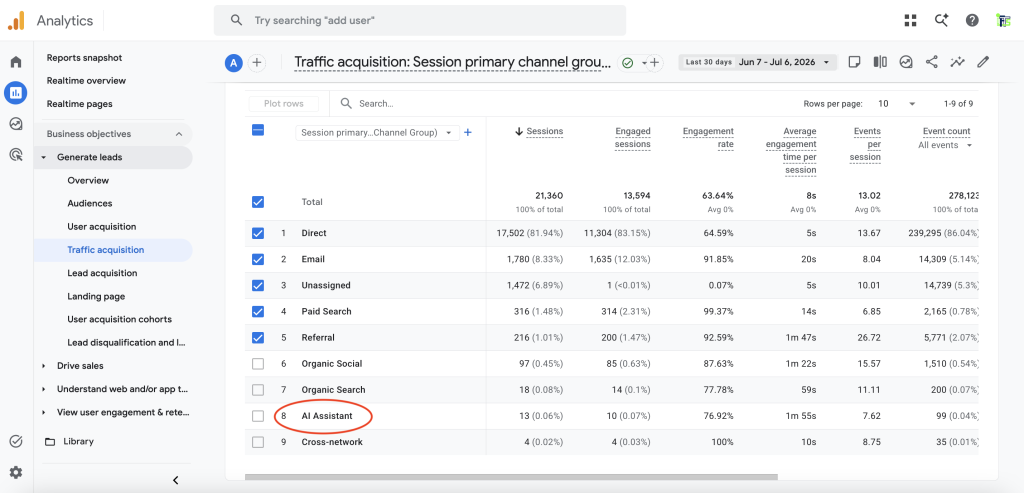
A year ago, if you opened your Google Analytics reports, you wouldn’t have seen traffic coming from ChatGPT.

Today, you might.

Google Analytics 4 is now beginning to show traffic from AI assistants like ChatGPT, and it’s one of the clearest signs yet that online search is changing.

 For years, businesses focused almost exclusively on ranking in Google.

Now, people are increasingly asking questions inside tools like:

  • ChatGPT
  • Grok
  • Google Gemini
  • Perplexity
  • And more…

They are asking AI instead of typing those same questions into a traditional search engine.

For law firms, that’s a significant shift.

It means your next client might discover your expertise before they ever perform a Google search.

And while the amount of AI traffic is still relatively small for many firms, the trend is moving in one direction.

Up.

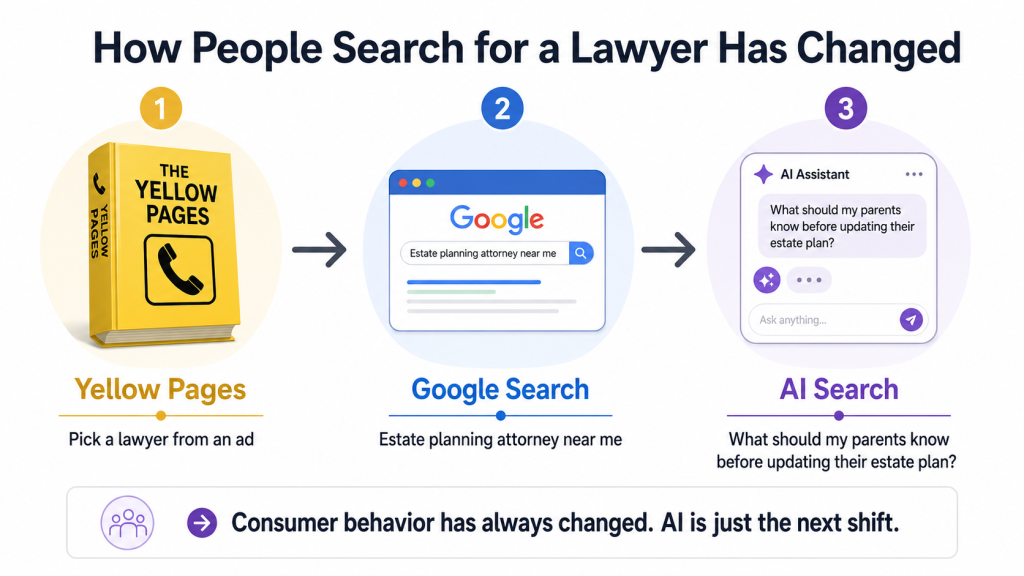
AI Search Isn't Replacing Google…It's Expanding Search Capabilities

Whenever a new technology appears, people tend to assume it replaces the old one.

However, that usually isn’t what happens.

When smartphones became popular, computers didn’t disappear.

When social media became mainstream, websites didn’t disappear.

The same thing is happening with AI.

People still use Google and Bing…but now they’re also asking conversational questions inside AI assistants.

For example, instead of searching:

“Estate planning attorney Pittsburgh PA”

Someone may ask:

“I’m retiring next year. What should I know about updating my estate plan?”

That feels more natural and it’s how a human thinks.

So, this means AI has to decide which sources it trusts enough to reference when answering.

The obvious question becomes:

How does your law firm become one of those trusted sources?

Fortunately, the answer isn’t nearly as complicated as many people think.

Step One: Create Content That Answers Real Questions

The first thing AI systems are looking for is useful information.

That sounds obvious, but it’s surprising how many law firm websites still focus almost entirely on talking about the firm instead of helping potential clients.

People want to know “What’s in it for me?” 

They don’t care as much about what school you went to or how many years you’ve been in business.

Think about the conversations you have every week.

Clients ask questions like:

  • Do I need a will or a trust?
  • How long does probate take?
  • What should I do after a car accident?
  • What happens after I’m arrested for a DUI?
  • How is child custody determined?

Those are exactly the kinds of questions people are asking AI tools.

If your website contains thoughtful, educational answers to those questions, you’ve already taken the biggest step toward becoming more discoverable.

This doesn’t mean writing hundreds of pages overnight.

Start small.

One new question answered each week becomes more than 50 pieces of evergreen content every year.  You can answer the question via video or a blog (or both!)

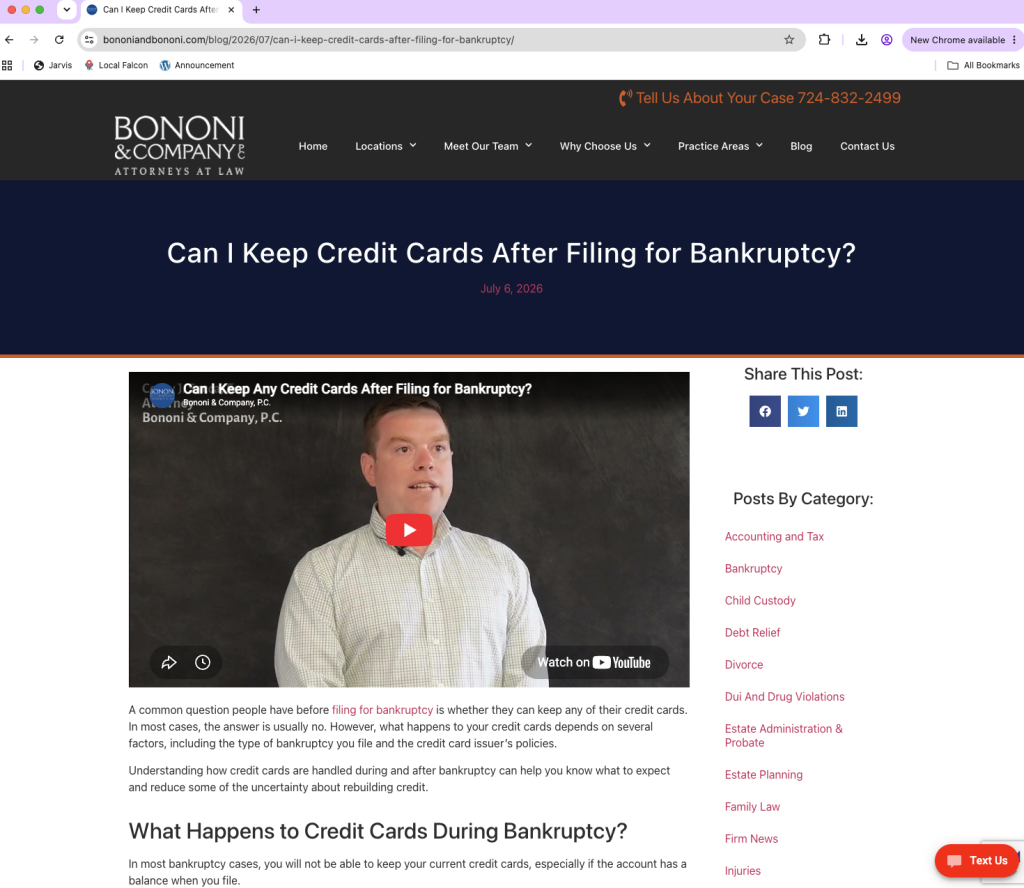
screenshot of law firm website answering an FAQ
The best AI-friendly content often starts with the questions you're already answering every day.

Step Two: Publish Your Expertise in More Than One Place

One of the biggest mistakes we see is firms putting all of their expertise in one location.

Usually their website.

That’s a missed opportunity…for multiple reasons.

Today, your content should live in multiple places.

One educational blog can become:

  • a YouTube video
  • a LinkedIn article
  • several LinkedIn posts
  • Facebook content
  • Google Business Profile updates
  • an email newsletter

Not because every platform is equally important.

But because every platform reinforces your authority.  It also helps your SEO.

AI systems evaluate information from many different sources.

The more consistently your expertise appears online, the stronger those authority signals become.

This is also why we’ve spent so much time on this blog talking about repurposing content instead of constantly creating new content.

The goal isn’t to work harder.

The goal is to get more value from work you’ve already done.

Step Three: Write Like You're Talking to a Client

This is probably the simplest improvement most attorneys can make.

Write for your clients.

Not other attorneys.

Legal writing serves an important purpose inside the legal profession.

Marketing content serves a different purpose.

Your goal is to educate.

That means using language your audience actually understands. 

No Legal Jargon Allowed!

Instead of writing:

“Pursuant to Pennsylvania statute…”

Try writing:

“Here’s what usually happens if…”

Simple.

Clear.

Direct.

Interestingly, this helps both people and AI systems understand your expertise.

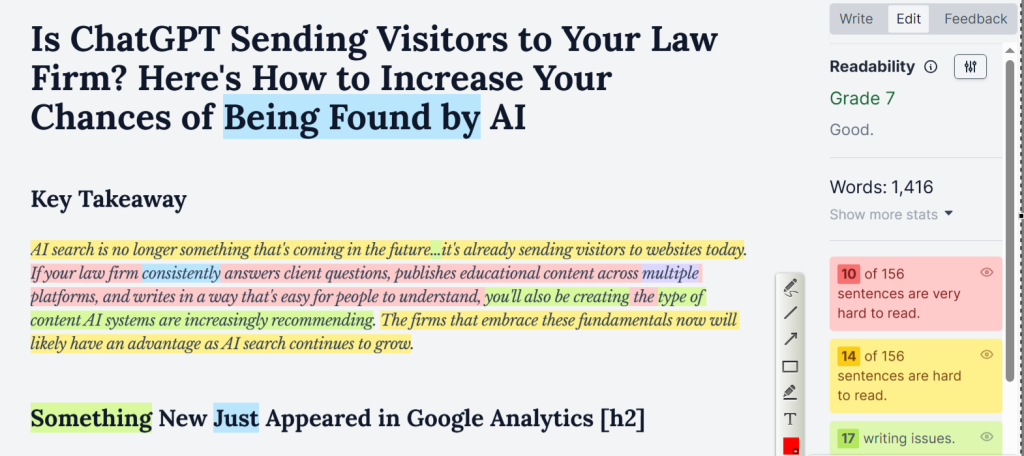
Tools like the free Hemingway Editor (https://hemingwayapp.com) can even estimate the reading level of your content and suggest ways to make it easier to understand.

Many of the highest-performing educational articles online are written around an eighth-grade reading level—not because the audience isn’t intelligent, but because clarity improves comprehension.

Simple writing isn't 'dumbing it down'—it's making your expertise easier to understand.

Good Marketing and AI Optimization Are Becoming the Same Thing

One of the biggest misconceptions right now is that businesses need some secret strategy to “rank in ChatGPT.”

In reality, many of the same things that have always made good marketing also make good AI content.

Helpful.

Trustworthy.

Consistent.

Educational.

If your marketing is focused on genuinely answering client questions and demonstrating expertise, you’re already moving in the right direction.  This is a good thing, you don’t have to do double work!

The difference is that those efforts are now helping you in more places than just Google.

Why This Matters for the Future

Nobody knows exactly what search will look like five years from now.

But we do know this:

Consumer behavior continues to evolve.

People are finding businesses through:

  • Google
  • YouTube
  • LinkedIn
  • AI assistants
  • referrals
  • social media

The firms that consistently publish useful educational content are building visibility across all of those channels at the same time.

That’s a much more resilient strategy than relying on one platform alone.

The Bottom Line About AI Traffic

You don’t need to panic about AI.

You don’t need to rewrite your entire website.

And you certainly don’t need to chase every new technology that appears.

What you do need is a consistent system for publishing useful, trustworthy information that helps potential clients solve real problems.

That’s what AI systems are looking for.

And more importantly…

That’s exactly what your future clients are looking for too.

Want Help Creating AI-Friendly Content That Also Helps With SEO?

At IFTS, we help law firms turn the expertise they already have into educational content that works across:

  • Websites
  • YouTube
  • LinkedIn
  • Google Business Profiles
  • AI search
  • Email marketing

without requiring attorneys to spend hours every week creating new material. Start ranking higher and getting found by the AI Assistants now!

Learn more about our Law Firm Kickstarter Kit here:

https://iftsdesign.com/kickstarter-kit

Why Smart Law Firms Don’t Depend on One Source of Clients

Key Takeaway

If your law firm gets most of its clients from a single source – whether that’s referrals, Google, networking, or anything else – you may be more vulnerable than you realize. 

Consumer behavior is changing faster than ever, and the firms that continue growing are building multiple paths for people to discover, trust, and hire them. The goal isn’t simply to generate more leads – it’s to build a marketing system that remains effective even as technology and consumer habits evolve.

What Would Happen If Your Best Source of Clients Disappeared Tomorrow?

It’s not a question most attorneys like to think about.

But it’s one every law firm should ask.

What would happen if:

  • your biggest referral source retired?
  • Google changed how it displays search results?
  • Local Service Ads became too expensive?
  • AI search tools started answering more questions before people ever visited your website?

Would your firm continue growing?

Or would you suddenly find yourself scrambling to replace a major source of business?

The reality is that many law firms become dependent on a single lead source without even realizing it. 

Everything works fine for years, and then something changes. The firms that adapt quickly survive. The firms that don’t often struggle.

That’s why smart law firms don’t rely on one source of clients.

They build multiple ways for potential clients to find them.

Consumer Behavior Has Changed Online

Ten years ago, the client journey was relatively straightforward.

Someone needed a lawyer…so they asked a friend…or they searched Google.

Today?

The journey is much more fragmented.

People are finding attorneys through:

  • referrals
  • Google searches
  • YouTube videos
  • LinkedIn content
  • Facebook recommendations
  • online reviews
  • AI tools like ChatGPT and Gemini
  • podcasts
  • webinars
  • email newsletters

And that list will definitely look different five years from now.

The challenge isn’t predicting which platform will dominate next.

The challenge is making sure your law firm isn’t dependent on only one of them.

The Five Major Discovery Paths for Law Firms

Let’s look at where potential clients are finding attorneys today.

1. Referrals

Referrals are still one of the most valuable lead sources available.

In many cases, they are also the highest-converting source.

People trust recommendations from:

  • friends
  • family
  • accountants
  • financial advisors
  • business contacts

In fact, Nielsen found that 84% of global respondents trust recommendations from friends and family, making word-of-mouth one of the most trusted forms of advertising.

The problem is that referrals are difficult to control.

You cannot force someone to send you a referral.

And if one major referral source disappears, your pipeline can feel the impact immediately.

That’s why referrals are fantastic – but dangerous as your only source of clients.

2. Google Ads and Search

Google continues to be one of the most important ways people discover law firms.

Potential clients are searching for:

  • estate planning attorneys
  • personal injury lawyers
  • family law attorneys
  • business attorneys

The challenge is that Google is constantly changing.

Over the years we’ve seen:

  • local map packs
  • Local Service Ads
  • featured snippets
  • AI Overviews

The firms that depend entirely on Google often find themselves reacting every time Google changes the rules.

3. YouTube

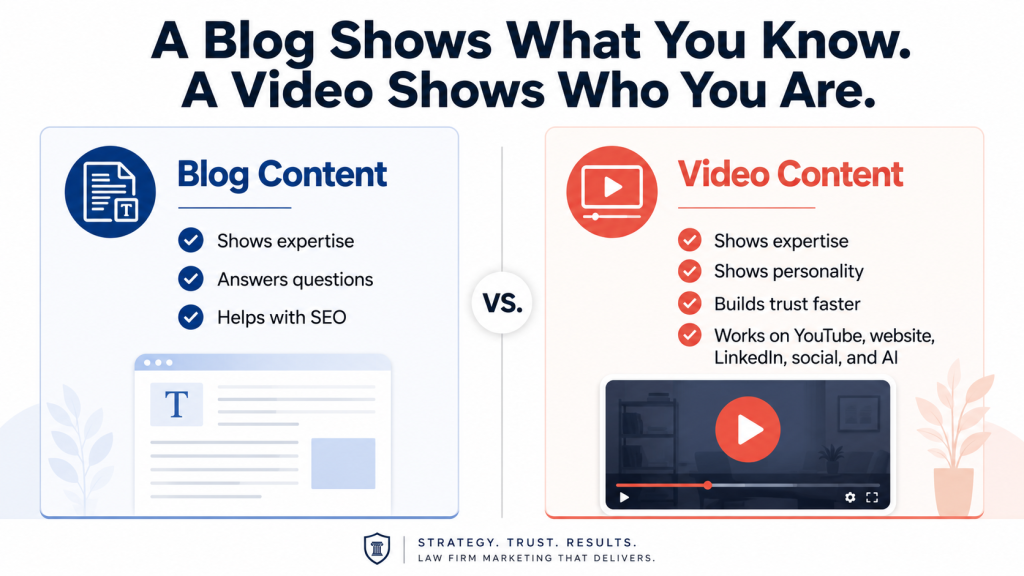
Video has become one of the most powerful trust-building tools available.

Before contacting an attorney, many people want to:

  • hear how you explain things
  • see how you communicate
  • decide whether they trust you

A well-produced educational video can answer questions and build credibility long before someone schedules a consultation.

That’s one reason we’ve spent so much time discussing video marketing on our channel and in our articles.

A single video can continue working for your firm long after it’s published.

4. LinkedIn

Many attorneys still think of LinkedIn as a networking site…which could be a mistake.

LinkedIn is increasingly becoming:

  • a referral visibility platform
  • an authority-building platform
  • a search asset
  • and a place where professionals evaluate expertise

The attorney who consistently posts useful information often becomes the attorney people remember first.

And when someone asks:

“Do you know a lawyer who handles this?”

Being remembered matters.

A lot.

5. AI Search

This is the newest category – and one many law firms are still ignoring.

More people are beginning to ask questions inside:

  • ChatGPT
  • Gemini
  • Perplexity
  • Google AI Overviews

Instead of performing a traditional Google search.

Nobody knows exactly how this will evolve.

But one thing is becoming clear:

Firms with strong content and authority signals across multiple platforms are likely to have an advantage.

The Biggest Mistake Law Firms Make

When attorneys hear this conversation, they often assume the answer is:

“I need to be on every platform, which is impossible. So I’m not going to waste my time.”

Trying to manually create unique content for every platform is usually a recipe for burnout.

However, the real solution is much simpler.

You need a system.

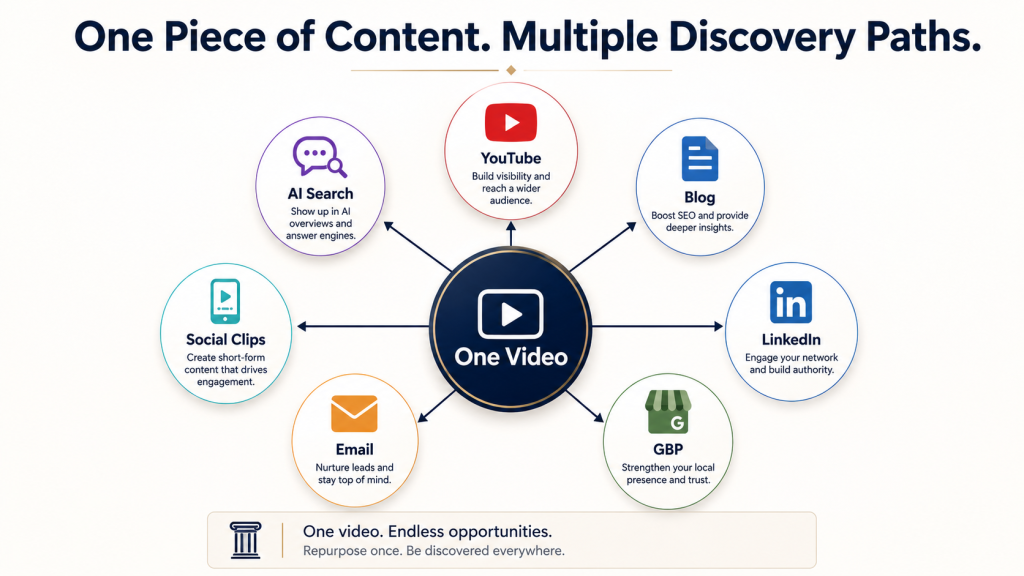
Use A System - Create Once, Distribute Everywhere

This is where many law firms are leaving opportunities on the table.

Instead of creating separate content for:

  • YouTube
  • LinkedIn
  • social media
  • email
  • blogs

You can create one piece of content and repurpose it.

For example:

One video can become:

  • a YouTube video
  • a LinkedIn post
  • a blog article
  • an email newsletter
  • multiple social media posts

The goal is not more work.

The goal is more visibility from the work you’re already doing.

The Firms That Thrive Build And Use Systems

The firms that seem to grow consistently over long periods of time usually aren’t relying on one magical tactic.

They’re building systems.

Systems that allow people to:

  • discover them
  • trust them
  • remember them
  • contact them

No matter where those people begin their search.

And that’s the real lesson here.

I don’t know which marketing channel will be the most important five years from now.

Nobody does.

But I do know that firms with multiple discovery paths are less vulnerable than firms that depend on only one source of clients.

Change Is The Only Constant In Marketing

Consumer behavior will continue to change.

Technology will continue to change.

Marketing platforms will continue to change.

The firms that adapt best won’t necessarily be the firms with the biggest budgets.

They’ll be the firms that build resilient marketing systems capable of reaching potential clients wherever they happen to be looking.

Because smart law firms don’t depend on one source of clients.

They build multiple ways for people to find them.

Want Help Building Multiple Discovery Paths?

At IFTS, we help law firms turn their expertise into content that can be distributed across:

  • YouTube
  • LinkedIn
  • Google
  • AI search
  • email
  • social media

without requiring attorneys to spend all day creating content.

If you’d like to test a simple system for building visibility across multiple channels, take a look at our Law Firm Kickstarter Kit.

It’s designed to help firms create content once and distribute it in multiple places—without adding more work to the attorney’s schedule.

Why LinkedIn Is Quietly Becoming One of the Most Important Platforms for Attorneys

Key Takeaway

Most attorneys still think of LinkedIn as a networking platform or online resume site, but it is increasingly becoming a searchable authority platform that can influence referrals, Google visibility, and AI-generated search results. The attorneys who consistently post educational, trust-building content are often the ones who stay top-of-mind when someone eventually needs legal help or referrals…and with AI tools helping firms repurpose existing content faster, staying visible consistently is becoming much easier than it used to be.

Previously, many attorneys treated LinkedIn as something you updated once every few years when:

  • changing jobs
  • speaking at an event
  • winning a big case
  • or adding a new certification

But honestly, I think LinkedIn is becoming much more important than most attorneys realize.

And not because it’s “social media.”

That is the wrong way to think about it entirely.

LinkedIn is increasingly becoming:

  • a referral visibility tool
  • a searchable authority platform
  • and part of how attorneys are being discovered online

That shift matters.

Especially as:

  • Google evolves
  • AI-generated search results become more common
  • and potential clients do more research before contacting a law firm

LinkedIn Is No Longer Just a Networking Platform

The platform has changed dramatically in the way people use it over the last few years.

Long-form articles, educational posts, commentary, and thought leadership content are becoming much more visible—not just inside LinkedIn itself, but increasingly in:

  • Google search results
  • AI-generated search summaries
  • and professional discovery searches

Even marketers like Neil Patel have started openly discussing how LinkedIn is evolving into a searchable authority platform rather than simply a short-term engagement platform.

According to LinkedIn’s own marketing research, professional and educational content is increasingly influencing how businesses build trust and authority online.

That’s a huge shift for attorneys because they already produce exactly the type of expertise-driven content LinkedIn tends to reward.

Why LinkedIn Matters So Much for Referrals

One of the biggest reasons attorneys should care about LinkedIn has less to do with SEO…and more to do with referrals.

Most referral sources:

  • do not need an attorney today
  • but eventually know someone who does

That’s important.

Because referrals often happen based on:

  • familiarity
  • visibility
  • and trust

Not necessarily because someone spent hours researching the “best” attorney.

And LinkedIn helps attorneys stay visible in a professional environment.

If someone consistently sees you:

…you stay top-of-mind.

Because when someone eventually says:

“Do you know an attorney who handles this?”

The attorney they remember first often has the advantage.

Online Visibility Compounds Over Time

One of the biggest misconceptions attorneys have about content marketing is that every post needs to generate immediate leads.

That’s not really how authority works.

The real value is cumulative visibility.

Most attorneys:

  • post a few times
  • disappear for six months
  • then start over again later

But consistency compounds.

Familiarity compounds.

Trust compounds.

The attorney who consistently shows up online often becomes the attorney people subconsciously associate with that area of law.

And honestly, that’s one of the biggest opportunities LinkedIn creates.

Should Attorneys Be Posting on LinkedIn?

In my opinion: yes.

But not because you need to become an influencer.

The attorneys who tend to perform best on LinkedIn are usually:

  • educational
  • consistent
  • approachable
  • and visible

Not necessarily the loudest.

The reality is that many attorneys are already creating valuable content every day without realizing it.

Every consultation, FAQ, webinar, or legal explanation is a potential piece of content.

The firms that consistently publish useful insights often build stronger:

  • authority
  • visibility
  • referral awareness
  • and long-term trust

Especially as AI-generated search continues evolving.

LinkedIn Is Increasingly Becoming an SEO and AEO Asset For Law Firms

This is another area many law firms are underestimating.

LinkedIn content is increasingly being:

  • indexed by Google
  • surfaced in search results
  • referenced in AI-generated summaries
  • and used as part of broader authority signals

That means your LinkedIn content is no longer just a “social post” that disappears after a few days.

It’s increasingly becoming searchable content.

And as AI search tools like:

continue evolving, authority-based content across multiple platforms becomes more important.

Your future clients may discover:

  • your LinkedIn article
  • your LinkedIn post
  • or your commentary

…before they ever visit your website.

That’s a very different internet than we had even a few years ago.

What Attorneys Should Actually Post on LinkedIn

This is where many attorneys get stuck.

They know they should probably post more consistently…but they do not know what to say.

The good news is that you do not need to reinvent the wheel.

Most attorneys are already explaining useful information every single day.

Some of the best LinkedIn content for attorneys includes:

  • answering common questions
  • explaining common mistakes
  • discussing legal trends
  • simplifying confusing topics
  • or sharing practical insights

Examples:

  • “What happens after a DUI arrest?”
  • “Do I need a will or a trust?”
  • “The biggest mistake business owners make before forming an LLC”
  • “What most people misunderstand about probate”

That kind of content performs well because it:

  • educates
  • builds trust
  • and positions the attorney as approachable and knowledgeable

Take note – you do not need to become some full-time influencer.

You simply need to:

  • educate
  • explain
  • and stay visible consistently enough to remain top-of-mind.

3 Simple LinkedIn Post Ideas for Attorneys

If you’re not sure where to start, here are three easy content types that tend to work well:

1. Answer Common Questions

Turn the questions clients ask every day into short educational posts.

2. Explain Common Mistakes

example of a social media post from a law firm answering the question "where should i store my estate planning documents?"

3. Comment on Legal or Business Trends

Share practical commentary on:

  • AI
  • cybersecurity
  • business law changes
  • estate planning trends
  • New story in your area
  • or legal developments affecting clients
example of a social media post from a law firm

Simple educational content often performs much better than overly polished marketing content.

Need more help or want a GPT to create these posts for you? Check out our article on How Lawyers Can Create LinkedIn Content in Under 60 Seconds (Without Writing Long Posts).

How Does AI Fit Into The Law Firm Marketing Picture?

Now obviously, one of the biggest challenges for attorneys is time.

Most attorneys:

  • do not want to spend hours writing LinkedIn posts
  • do not want to constantly film videos
  • and do not have time to manually repurpose content all day

That’s where AI can become incredibly useful.

For example, AI can help law firms turn:

  • blogs into LinkedIn posts
  • webinars into articles
  • FAQs into short-form content
  • videos into written summaries

And that operational efficiency matters.

At IFTS, we also use Video Twins and AI avatar systems to help firms scale approved attorney content more efficiently.

And just like we discussed in our article How Law Firms Can Use AI Ethically for Marketing…we only allow AI to say things the attorney has already said.

The goal is not replacing attorneys.

The goal is helping firms distribute approved expertise more consistently without dramatically increasing workload.

The Firms That Stay Visible Online Often Win

At the end of the day, most attorneys already know enough to create valuable content.

The challenge is consistency.

This is one of the biggest opportunities right now for firms willing to take LinkedIn seriously.

Because while many attorneys still think of LinkedIn as:

  • “just social media”
    or
  • “an online resume”

…it is increasingly becoming:

  • an authority platform
  • a referral visibility platform
  • and a discoverability platform

Especially as AI-driven search continues evolving.

Want Help Creating This Type of Content Consistently?

At IFTS, we help law firms turn:

  • blogs
  • FAQs
  • videos
  • webinars
  • and existing attorney expertise

…into scalable marketing systems that improve:

  • visibility
  • referrals
  • authority
  • and lead generation

You can learn more about how to get started here: Law Firm Client Kickstarter Kit

We only work with one law firm per practice area per county, so availability is limited.

Frequently Asked Questions

Yes. Consistently posting educational and professional content helps attorneys stay top-of-mind with referral sources who may eventually know someone needing legal help.

Increasingly, yes. LinkedIn articles and posts are showing up more often in Google search results and AI-generated search summaries.

Educational content tends to perform best, including FAQs, common mistakes, legal trends, and simplified explanations of complex legal topics.

No. Consistency matters more than frequency. Even posting once or twice per week consistently can help improve visibility and authority over time.

AI can help repurpose blogs, webinars, FAQs, and videos into LinkedIn posts, summaries, and educational content more efficiently.

They can be when used responsibly. AI Twins should only communicate information the attorney has already approved or previously stated publicly.