
Is your website ready for the next Google SSL update and how will it impact your business?

Does your website start with “http://” or “https://”?

If it is the former rather than the latter, your website visitors (and your business) may have a large surprise starting October 1, 2017!

According to Google, “Starting October 2017, Chrome (version 62) will show a “NOT SECURE” warning when users enter text in a form on an HTTP page, and for all HTTP pages in Incognito mode.”

More simply put, if your site does not have an SSL certificate on October 1, 2017, Google Chrome will mark it as “NOT SECURE” if there are any text fields.

What does an SSL do for me?

SSL (Secure Sockets Layer) Certificates encrypt the connection between the web browser and the server where the website resides. This makes it much harder for someone to intercept the traffic and steal the information, which in turn leads to a safer browsing experience for the average web user.

This is the second step in Google’s plan to force users to employ an SSL certificate. Step one was implemented in January of this year. It marked sites as “NOT SECURE” if they did not have an SSL certificate and accepted personal data, like credit cards or PayPal. This step, implemented October 1, will mark any site with text fields as “NOT SECURE” without an SSL. The final step, planned to roll out soon, is to mark any site as “NOT SECURE” that does not have an SSL certificate.

Because it is so much more secure, Google would prefer to have all websites protected by an SSL certificate. They have reinforced this notion in their ranking algorithm as well, with SSL protected websites ranking more highly.

What does this mean for you?

Your business and your website traffic are at risk with no SSL certificate!

What should I do to avoid this situation?

Talk to your webmaster or the person that handles your website hosting about adding an SSL.

Don’t have an SSL or not sure where to start?

Contact Integrity First Technology Solutions, Inc. (412.559.7177 or si@iftsdesign.com) and let them take care of it for you.

Don’t miss this opportunity to upgrade your website. Protect your clients and your website’s reputation!

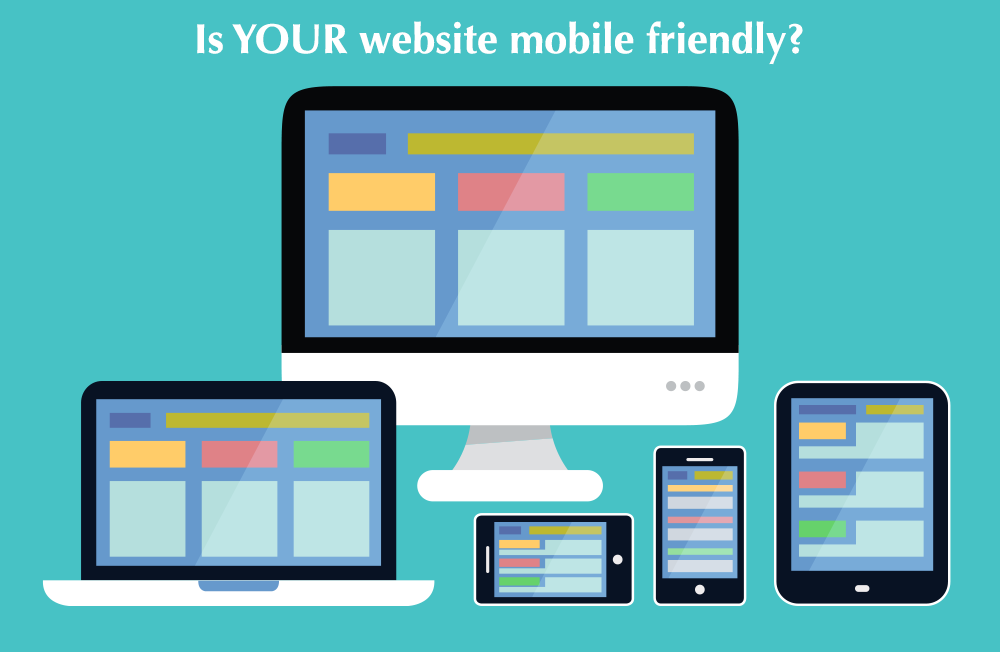
Google wants YOUR website to be mobile friendly right NOW…Is it?

Is your website mobile friendly?

According to Google’s Webmaster Blog, “To improve the mobile search experience, after January 10, 2017, pages where content is not easily accessible to a user on the transition from the mobile search results may not rank as highly.”

What does this mean for your business?  

If you want to rank highly on Google’s search results, your website has to be considered mobile friendly.


What does mobile friendly even mean?

When you open a business’s website on your phone and you have to pinch the screen to zoom in so that you can read it, that is indicative of a non-mobile friendly site.  The website does not distinguish how it shows up based upon the device on which it is being viewed.  If you make it more difficult for someone on your website to access information, they are much more likely to leave.


Why did Google do this?

According to Marketing Land, 60% of consumers time is spent browsing the internet on their mobile devices.  Additionally, 75% of people will search on their phone for a business that they want to connect with  (Google Partners).

Google wants to make browsing the internet as easy and as safe as possible for the average web user.  Therefore, they are going to return websites in the search results that they believe exhibit these traits.  If you are not one of these websites, your ranking position is likely to drop.

Even worse, if your competition IS one of those mobile friendly websites, their position is likely to rise.


What do I need to know about Google’s mobile friendly algorithm?

Important updates to be aware of are (Search Engine Land):

  • The new mobile friendly algorithm was rolled out in January 2017
  • It is an on or off algorithm, which means that you are 100% mobile friendly or you are not
  • It will be on a page-by-page basis


How do I know if my site is mobile friendly?

Google has released a tool where you can check your site for mobile friendliness: https://search.google.com/test/mobile-friendly


If you have employed one of the following techniques, your website will be considered mobile friendly:

  1. Adaptive Design: Your website changes the content served based on the viewing device.
  2. Responsive Design: Your website has a fluid layout that changes based on the viewing device.
  3. Mobile-Only site: You have a separate mobile site that shows only on mobile devices.  This is no longer recommended because Google indexes your mobile site only.


What should I do if my website is not mobile friendly?  I want to be returned highly in the search results!

If you do not have a mobile friendly website, there are four options to explore.

  1. Additions to Existing Website:  You can make responsive additions to your existing website that will allow the site to account for the viewing device.
  2. Website Redesign:  You can redesign your website as a responsive website, which will ensure that it shows properly on all devices.  Additionally, you can add in other changes for other Google updates, such as the new SSL requirement.
  3. Create a Separate Mobile Site:  You can keep your site as is and have a mobile site that is served only to mobile users.  Again, this is not recommended because Google now indexes your mobile site only.
  4. Do Nothing: If you do not want to rank highly on Google’s search algorithm, then you can leave your site as is.


Need help implementing options one, two or three?  Contact IFTS, Inc. for more details.


Does my Business Need a Website?

Example website for a company

If you are asking yourself, “Does my business need a website?” the answer is unequivocally “YES!”  Over 2.6 billion local searches are performed monthly (Small Business Community – https://smallbusinesscommunity.org/2013/03/15/online-marketing-for-local-business-introduction/).  Having a website isn’t just for e-commerce anymore; it’s a must for any legitimate business.  Your website should be the hub to your marketing plan.

You should implement a website for a number of reasons:

  1. Websites provide your contact information and location easily: 43% of searches use a local keyword.  86% of those convert to a phone call or visit to your physical location, according to SE Leads (http://localvox.com/resources/marketing-statistics/).  People aren’t just relying on the Yellow Pages or other print directories anymore. Instead, they’re trusting Google to list local businesses based on their search terms and location.
  1. Websites provide information about your business: Businesses spend thousands of dollars creating paper brochures and fliers that end up being thrown away or misplaced on desks.  Having a website allows you to change information real-time without having to pay printing costs. Customers and prospects will always receive the latest information when they visit your site.
  1. Websites allow you to attract new customers: Over 2.4 billion people use the internet daily.  By not having a website, you miss out on these potential customers.  Have you ever heard a business owner say, “No thanks, I have enough business”?
  1. Websites can establish trust and credibility: What your website looks like affects the perceived value of your business.  If it looks unappealing, is rife grammar mistakes and has broken functionality, people are going to assume that your business is exactly the same: dysfunctional.  Your website is a reflection of you and your business.  By having one that is grammatically correct and well structured, your business will gain instant credibility and represent the true nature of your expertise.  One important thing to remember is that it is BETTER TO HAVE NO WEBSITE THAN A BAD ONE.
  1. Websites can provide reviews, testimonials and your completed projects: People like to see that you are capable of doing the work that they want to hire you to do.  They also like to know that other people enjoyed working with you.  Therefore, providing customer testimonials or allowing reviews of your company online help to showcase your expertise and the qualities that make working with you unique.  You can also provide details of completed projects, showing the quality of your work.
  1. Websites provide the opportunity for a Vanity Email: Along with your site comes the ability to have an email address that is you@yourwebsite.com.  You may think that the Gmail, Yahoo! or Hotmail account that you currently have is fine, but it lacks professionalism.  A vanity email is much easier to remember and will resonate with your clients.  A 2015 Verisign study concluded that 65% of consumers consider a vanity domain to be more credible than a generic email account.
  1. Websites allow you to have a company blog or event page: A blog or event page on your site allows you to provide your clients with your latest promotions, events, discounts and more.  The blog also allows you to establish your expertise with your customers by writing high quality content that is relevant to them and your field.
  1. A website allows YOU to save time and money: Your website provides your clients with 24/7 access to your company and any information that you provide.  If you add a customer portal, ticketing system or even an FAQ section, you will streamline your process and decrease YOUR cost of customer support.
  1. A website allows you to keep up with your competition: I can guarantee that at least one of your competitors is online and if you are not, the additional people that they can reach will not even know about you.  Why make it easy for another company to beat you?  A good site can help level the playing field between big and small companies.

If you want to establish rapport with a broader set of customers, provide up to date information about your company, easily answer questions from clients, reach a new set of prospects and compete with your largest competitors, then a website is for you.  Integrity First Technology Solutions can help you create a successful website and more.  Contact us today!