Why Should Online Reputation Matter to a Small Business?

Small businesses (especially those with local brick and mortar locations) seem to underestimate the importance of having a positive online reputation.  Without national or international customers, you may ask – “What’s the big deal?”

The big deal is that 82% of searches done online are followed up with an in-store visit!

It is very clear that local consumers are utilizing the internet to research businesses close to them.  The real question is, “What is the internet telling them about you?”

Any business that is not taking this seriously risks losing business…to your neighbors that position themselves online well (even if their product isn’t better than yours)! 

Just How Important Is It to Create a Positive Web Presence?

When looking for great service or a great price, local consumers turn to their phones and tablets.  With just a few clicks, they are able to peruse Google, Bing, social media, other review websites and forums for businesses that have exactly what they are looking for.  

Your company may have an amazing product at an unbeatable price with the world’s best customer service, but if your online presence does not reflect this and you have negative social signals, you will have a very hard time convincing new customers to trust you…and pay for your product.

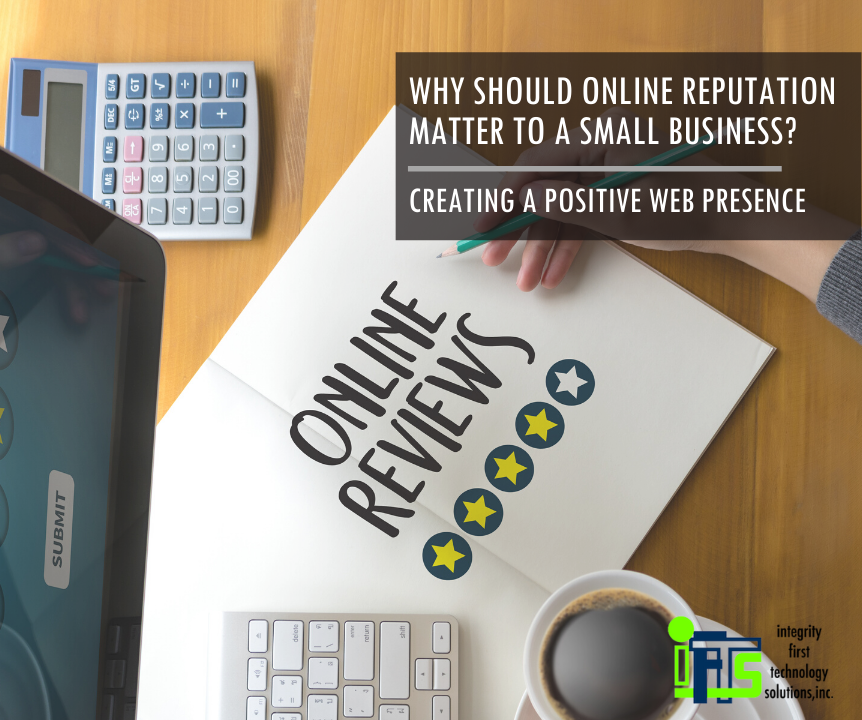
Many people are using word of mouth on social media, online reviews and company content to make informed buying decisions.  In fact, more than 90% of people trust online reviews as much or more than a recommendation from a friend or colleague!

Two important questions to ask yourself when it comes to your online presence are:

  • When your ideal client searches for your product (or service) near your location, do you show in the search results or the maps results?  
  • If so, does he or she see a professional online face to the world with glowing reviews?  

If you answered “No” to either of the previous questions, the chances are that you just lost a great customer.

What are the Benefits of Online Reputation Management?

You need to have a positive web presence for the survival of your business.  It can help:

  • Establish your credibility with positive testimonials
  • Give you an edge over your competition
  • Build trust with current and future clients

Position your company as the first and best choice for your ideal clients.  When they are researching, you need to be the obvious decision.

A well-positioned online reputation is also your best sales person, working for you 24/7/365, especially to those people in your community searching for your specific offering.

Finally, having good reputation management can help you rank higher organically in search engine results, which will expose your business to more customers.  Good reviews that mention where you are, what you do and your company name will help tell Google a bit more about your offerings.

How Can a Small Business Build a Positive Online Reputation?

Your website, print advertisements and social media posts are not the only things that make up your web presence.  It is a much wider net than most realize.  Your online reputation does include those things, but it also is made up of reviews from various review sites, comments on your website or blog, “complaint forum” threads, “Top 10” lists that your company may have made, photos tagged with you or your business and much more.  Anywhere that you (or your business) is mentioned, tagged, linked to online – that is all part of your online presence.

Managing all of this seems like it could be akin to “herding cats”, but there are a few impactful steps that you can concentrate on to start.  This will help ensure the future success of your company.

Step 1 – Monitor Your Online Reputation

The first step to taking control of your online reputation is to monitor it daily.  You can handle this yourself or you can outsource this activity, but it is very important that someone is watching.

You need to make sure that you know exactly what your ideal client is looking at online about you.  If you find any negative information, be sure to remedy that quickly.  With so many products and services available to today’s consumer, there is no reason for him or her to trust you (or buy from you) if there is negative information readily available about your business.

Step 2 – Acquire Positive Reviews and Mitigate Negative Reviews

Online reviews are one of the major factors when it comes to your online reputation.  Remember, 90%+ of people trust online reviews as much as or more than a friend or colleague.  This is why there are more important than any content that you could create.

How many times have you seen a company with multiple one-star reviews and decide to buy from them anyway?  I would bet on a very small amount.

Be sure to create an automated system for monitoring, soliciting and responding to reviews that you receive.

If you happen to receive a negative review, it is imperative that you respond to it quickly and with a level head.  Remember, your response is for your future clients and not the person that left the bad review.  Be sure to apologize that they had a negative experience and offer to talk about their issue offline.  This way, people can learn something positive about your company (that you care about your customers) from a negative review.

Step 3 – Get on Social Media

Where do your clients hang out online?  Are they on Facebook? Twitter? Instagram? LinkedIn?

Do a little research and find out where they are most likely to be active.  Then, concentrate on those social networks and build your profile to be attractive to your ideal client.  Be sure to completely fill in the profile and include photos and videos to keep it engaging.

By keeping your social media simple, it will help you avoid overwhelm and really concentrate on activities that will give you the best ROI.  Create a schedule for posting regularly and use a tool that helps you automate the process.  This allows you to use social media for your business, but cut the time that it takes in half.

Leveraging Your Online Reputation

You’ve worked hard on your business over the years to build up your name!  Don’t jeopardize that fact by neglecting to build and monitor a positive online presence.

Overwhelmed or unsure where to start?  Contact IFTS to learn more about our online reputation management program and steps you can take to better position your business.

How To Get More Clients Using Facebook

The best social media platform by far that all small business owners should be on is Facebook. With over 2.6 billion monthly users, this social network absolutely dominates the online space. According to a study done by Pew Research Center, 74% of Facebook users visit the site every day, which is more than any other social network. Finding success with using Facebook to market your business isn’t hard, but it does take some time to figure out how to best utilize the platform to engage with your customers and drive more leads.

Running your own business can be very stressful on it’s own, but finding ways to get new clients and keep them coming in can be one of the greatest challenges. In this post, we will be sharing a few strategies that will help you get more clients through Facebook.

1. Create a Facebook page for your small business

It’s totally free to create a Facebook page for your business and it only takes a few minutes! Complete these 3 easy steps so you can begin to reel in leads and make sales!

2. What should I post on my business Facebook page?

Now that you have your page set up, what should you post about? Don’t be afraid to switch up your strategy and share different versions of written and visual content such as:

  • Tips and tricks
  • Blog posts you have written or from other relevant websites
  • Engage with other facebook pages and share their posts
  • Ask questions to engage in conversation
  • Share photos or videos that your audience would benefit from
  • People love to see what happens behind the scenes! Show them “a day in the life” or what it looks like when packing orders if that suits your business!

3. When should I post on my Facebook page?

Timing your posts depends on your audience and when they spend their time engaging on social media sites. You can post as many times a day as you want, but make sure to be consistent with posting at least one thing every day. The best way to figure out what the best time to post for your business is to test different times with similar content. Consistency with testing is going to accurately measure results so be sure to use the same or very similar content when it comes to testing so that your results are not skewed. If you want more information on specific times to post that may work for you, check out our Best Time to Post on Social Media blog. Here, we go into more detail on experimenting with your social channels to find the perfect time to engage with your audience and how to get started on the right foot!

4. I don’t have much time to post on Facebook!

I know what you’re thinking; posting on Facebook one to three times a day can sound overwhelming.. Especially if Facebook is not the only social platform you are active on! This is where a social media management tool comes in handy to take care of posting for you. With a tool like Hootsuite or Sprout Social to name a few, you can schedule all of your posts in advance, saving you time to spend on other areas of your business. Check out our previous post where we go into detail about the top 3 social media management tools to help manage all of your pages and profiles in one place!

5. Use Facebook Ads!!

Facebook offers paid placement ads on their website and mobile apps where your content, special offers, website and posts can get in front of customers with a few clicks. What’s even better is you can target your ads to a very specific demographic. Now you may be wondering how much it costs to run facebook ads. The answer to this question depends on your budget and your goals but you can allocate as little or as much as you want per day. Although Facebook ads can reach a mass group of users, don’t put your entire marketing budget behind Facebook ads. Test with a small budget and scale up from there as you find out what works best for your business.

6. Actively participate in Facebook groups

Join facebook groups where you feel that your ideal client might be present. For example, if you are a graphic designer, you might want to join groups that include bloggers or small business owners as these are people who could benefit from your services. Now, you don’t want to come off as spammy or self promoting right off the bat, so what you can do is just be outrageously helpful when people ask questions in the group. Group members will take note of your expertise and hopefully check out your profile that should be linked to your business’s Facebook page. This technique does require some time and effort, but is one of the best ways to get leads from Facebook.

These strategies will help you to increase your engagement on facebook and generate leads that will hopefully turn into loyal customers!

How To Define Your Target Audience

Marketing isn’t just the practice of placing ads, rather it’s a method of attracting new business. You have to know exactly who you want to target with your marketing – your target audience will not simply be “everyone”. Your task in defining your target group is to identify and understand your particular niche so you can dominate it. 

The better you understand your target market, the easier you’ll be able to target them with relevant content that will stand out. 

In this guide, we’ll walk you through a few steps that will help you to understand who is already interacting with your business (and competitors) and use that information to develop a clear target group.

What is a target market?

A target market is a specific, defined segment of consumers that a company plans to serve with its products or services. These are the people who are most likely to purchase your products or services and have common characteristics such as demographics and behaviors. Identifying your target market is an essential step in the development of products, services, and the marketing efforts used to promote them.

Market segmentation is the process of dividing a market of potential customers into groups, or segments, based on these different characteristics. The segments created are composed of consumers who will respond similarly to marketing strategies and who share traits such as similar interests, needs, or locations.

There are 4 types of market segmentation:

  1. Geographic segmentation –  involves grouping potential customers by country, state, region, city or even neighborhood.
  2. Demographic segmentation – divides a market through variables such as age, gender, education level, family size, occupation, income, and more.
  3. Psychographic segmentation– focuses on the intrinsic traits your target customer possesses. Psychographic traits can range from values, personalities, interests, attitudes, lifestyles, and opinions.
  4. Behavioral segmentation– focuses on specific reactions and the way customers go through their decision making and buying processes. Attitudes towards your brand, the way they use it, and their knowledge base are all examples of behavioral segmentation.

Marketers can use segmentation to prioritize their target audiences. If segmentation shows that some consumers would be more likely to buy a product than others, marketers can better allocate their attention and resources. The purpose of segmentation is that you are able to introduce a more tailored message that will be received successfully. 

What is a target audience?

A “target audience” is more narrow than a “target market”. It refers specifically to the group of consumers targeted by marketing messaging. A target audience is a group of people that has significant potential to respond positively to a brand message. Your target audience may or may not be the end users of your product, but they are the people you plan to direct your marketing to. 

To communicate effectively with your target audience, you need to understand who they are and what their true needs and desires are. 

How to define your target audience

  1. Know the value of your product/service

When identifying your target audience, it is important to determine the features of your product or service. What needs does your product or service fulfill for a potential customer? How does your product or service differ from others in your industry? Is your product more affordable? Is it more effective? These are some things that need to be taken into account before figuring out who will be on the receiving end of your marketing efforts. Think about those who may be interested and who might benefit from your product or service. These are the people that will make up your target audience.

  1. Get to know your existing audience

When trying to figure out who wants to buy from you, a great first step is to identify who is already using your products or services.

How old are they? Where do they live? What do they do for work? What social networks do they use? Do they scroll through their feeds on a mobile device or the computer? These are all questions that you need to be able to answer about your current customers, and once you understand their characteristics, you can go after more people who fit the same mold.

One way to start is by gathering whatever information you have about your existing customers. Some data points that you may want to consider are:

  • Age: This is one area that doesn’t need to be too specific. Whether your average customer is 23 or 27, it won’t really make that much of a difference. Rather knowing which decade of life your customers are in, or their generation can be much more useful.
  • Stage of life: are your customers college students? Parents of young children or teens? Retirees?
  • Interests: what do your customers like to do? What other businesses do they interact with?
  • Location and time zone: Where in the world do your existing customers live? If you’re based in the PST time zone and have followers in the EST and GMT time zones you might find posting at 8 a.m. PST works best because it hits the workday in both other regions. Understanding where your customers are located geographically is so important when deciding what time you should post to ensure best visibility. 
  • Spending patterns: How much money do your current customers have to spend? How do they approach purchases in your price category?
  1. Check in on Your Competition

Now that you have a better idea of who is already interacting with your business, it’s time to dig a little deeper and see who’s engaging with your competitors. 

Looking into who is interacting with your competition can answer some key questions: are you and your competitors both going after the same market segments? Who are they currently targeting? Are they reaching segments you hadn’t thought to consider? 

You won’t be able to get detailed research about the people interacting with your competitors, but you’ll be able to get a general sense of approach they’re taking and whether that is allowing them to create engagement online.

Define your target market and revise as needed. You shouldn’t think of your target market as set in stone. As you learn more about your customers, how you define your target market will most likely change. So, work to understand who your business serves, and why they should care. 

As your business grows, your target audience may change, and finding this specific group of people should be a continual effort.