10 Of Our Favorite Marketing Hacks For House Painting Companies In 2022

Would you like to know about our 10 favorite super sneaky marketing hacks that you can implement today?

We use these marketing secrets to help our painter clients rank their website #1 for their favorite keywords, get more organic traffic and ultimately, get more leads to grow their business.

In this article, we are going to cover ten actionable strategies that you can use RIGHT NOW.

The best part?

You don’t have to be super tech savvy or Elon Musk to get them implemented.

Let’s start this section with our favorite Google Business Profile hacks.

Hack #1 - Social Proof Will Get You More Leads

The best two platforms to get reviews on are:

  • Google
  • Meta (Formerly Facebook)

Google reviews are the best type of reviews that you can receive because not only do they talk you up and show people how great you are, they also help your website with its SEO.  As an added bonus, once you have 100 reviews, your star rating will be shown when you run Google ads.

Meta reviews are great to have as well because of the platform’s popularity in a house painting company’s target market.  Most house painters that we work with have a target audience of women that are between the ages of 35 to 64.  Consequently, that is the majority of Meta users.  By using this platform, you are more likely to get in front of your ideal client than any other social media option.

If you can get a video testimonial from a client, that can go a long way as well.  A lot of people get stuck on the logistics of creating the video, but it shouldn’t be that hard.  You can interview them via Zoom and record that call or just have them use their phone to record a quick video. 

The more authentic the video looks, the better.  This is for two reasons.  One – if the video is over-produced, it will seem scripted and less credible.  Two – if people see that someone took time out of their day to create a quick video for you, it shows that they really liked you and your work.

Once you have these videos, be sure to put them everywhere a potential audience may look.  This could include:

  • YouTube
  • Your website
  • Social Media
  • Your Google Business Profile
  • and more!

Reviews are a great way to show how great you are without you ever having to say a word.

Want some help getting more reviews?  Check out our article on implementing a review system.


Hack #2 - Get Your Listing On Google Maps

Getting your business listed in the Google Maps results is based on many factors.  A few big ones are:

  • how close the searcher is to your business location 
  • your review ranking and volume (which we discussed above in Hack #1)
  • profile completeness
  • local signals

To start, make sure that your profile is completely filled out with correct information.  Your name in the Google Business Profile should match exactly the name on your website.  This goes for your address, website, and phone number as well.  Then, be sure that your business categories and services are filled in completely.  

The final part of your profile that should be completed is the “Photos” section. Be sure to add as many photos as you can as this is a feature that not many painters take advantage of.

For a complete walkthrough of filling out a Google Business Profile, check out our article here: https://blog.iftsdesign.com/introducing-google-my-business/

“Local Signals” are another big factor for showing up early on Google Maps.  These are website links to your website from other local businesses or services.  A few examples of this would be:

  • a back link from the local chamber of commerce
  • a back link from a local scholarship that you sponsored
  • a mention or link to your business from a local paper

Anything that you can do to get your business associated with your area is a great “local signal” to Google.

Hack #3 - Ask and Answer Questions Via Your Profile

An easy way to get keywords and locations associated with your Google Business Profile is through the question and answer section.

Previously, you were not able to add questions to your profile yourself,  You had to wait for someone to ask and then you could answer them.  This has now changed.

The Q&A section of your Google Business Profile is a great way to show all of your most frequently asked questions up front to prospective customers.

Write down the 10 questions that you receive all of the time from prospects and then answer them in 3-5 sentences.  While you are answering them, be sure to use common keywords/phrases as well as locations that you want associated with your house painting business.

Once you have accomplished this task, copy and paste them to your Google Business Profile.

Now, we’ll move to our favorite Paid Ad Hacks.

Hack #4 - Solve Your Prospects’ Small Problems For Free In an Ad

What are the questions you most commonly get asked? If you’ve already implemented Hack #3 from this article, you should have this list already.

Side Note – Need some inspiration?  Check out https://answerthepublic.com/ or https://neilpatel.com/ubersuggest/ for commonly asked or searched questions in your field.

Make videos answering these questions and position yourself as the expert in your area.  Again, just like the testimonials, the videos do not have to be fancy or highly edited.  They should be authentic and can be filmed with your cell phone.  Some painters will even film on the job site.

Sample Common House Painter Questions To Get You Started:

How often should I paint the exterior of my house in this area?

  • What is the best time of the year to stain a deck?
  • How many coats of paint should be used on the exterior of your house?
  • How many coats of paint should be used on the interior of your house?
  • What does it mean for a painting company to be bonded and insured?
  • Should I paint my kitchen cabinets or should I replace them?

Once you have your videos, post them to your social media, YouTube channel and on your website.

You should also run them as Meta ads to your local audience.  You don’t have to spend a lot of money, just one to five dollars per day.  This helps you get in front of a fairly large group of people in a small amount of time.

These videos will help you create an audience that already knows/likes/trusts you when it comes to painting topics.  When they have a painting project come up, you will be the one that they know they can trust.

Hack #5 - Make Your Ad Stand Out

When creating your video, you want to be sure to stand out amongst the crowded marketplace.

The first way to do this is to use contrasting colors to the platform that you are running the ad on.  If you are going to run the ad on Meta (Facebook), we recommend having a red or yellow bar at the top of the video because it helps you stand out from the Meta blue color scheme.  An easy way to do some small edits to your video is through Canva.  

Don’t want to take the time to do any edits to the video?  Try wearing a brightly colored red or yellow shirt.

The second way to stand out is to immediately call out your audience or target market.  So, if you were advertising kitchen cabinet painting to the residents of Dallas, you could start your video with the sentence: 

“Are you living in the Dallas area and thinking about redoing your kitchen?”

Or, you could do some video editing and add that sentence as text to the beginning of the video.

A final way to stand out is to start your video with a big action or a memorable prop at the beginning.  You want to grab someone’s attention – movement or something unexpected will typically draw the eye.

A few big actions you could try:

  • come in through a door
  • big wave and a smile
  • use a paint sprayer or other tool of the trade
  • jump into the frame

A few memorable props you could try:

  • Comically large-sized paintbrush
  • Wall of stacked of paint cans
  • stand halfway up a ladder

The important thing to remember is you want to get their attention within the first 3 seconds of the video and keep them watching.  These tactics all use “pattern interrupt”.  This basically means – do something to get a person to stop scrolling through their feed and watch your video/read your ad.

Hack #6 - Use Retargeting Ads In Multiple Ways

The average consumer is only prepared to make a purchase about 3% of the time. 

So, how do you attract the other 97% of people?
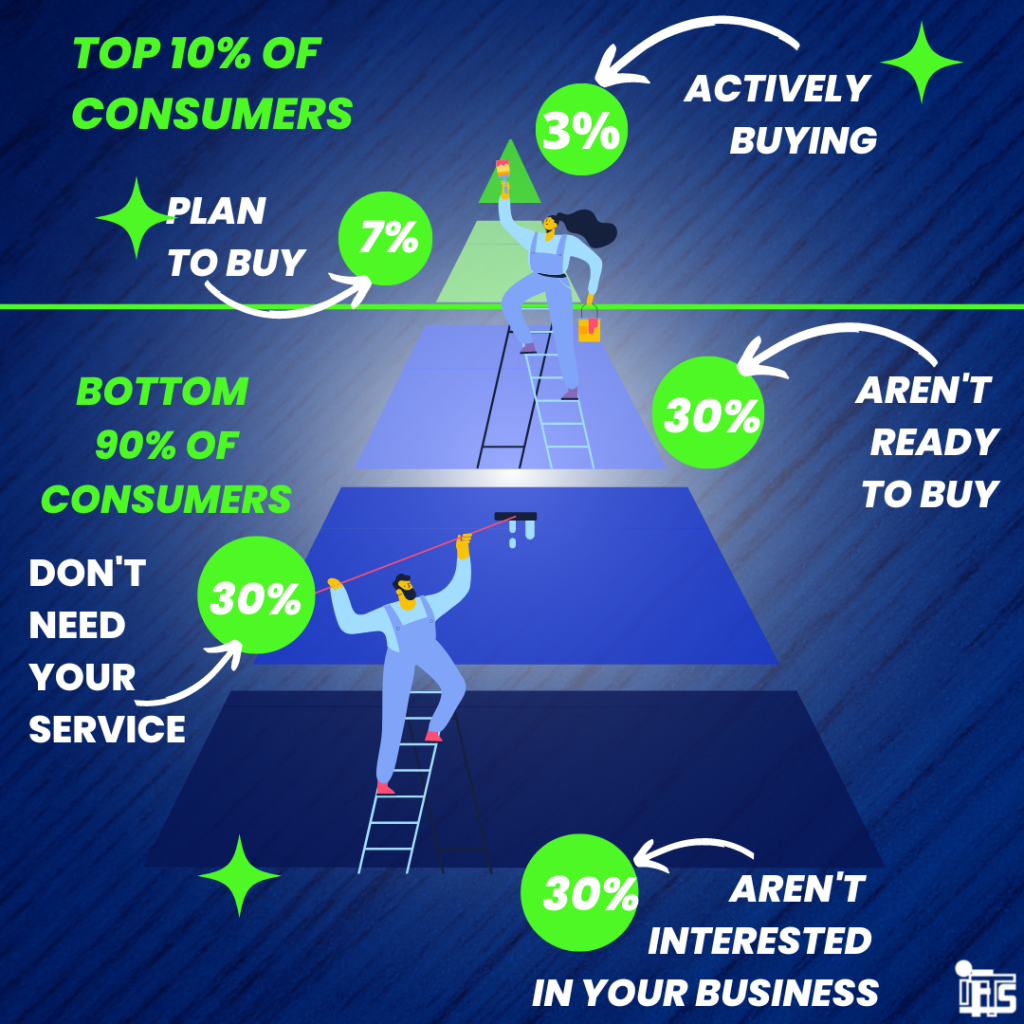
Retargeting Ads

Retargeting allows you to stay in front of someone that is interested in your services until they are ready to make a purchasing decision.  If you are advertising on Meta (Facebook), you can do this in 2 ways:

  • Meta Pixel
  • Video Viewers

The Meta Pixel is a small piece of code that you install on your website.  It then tracks who has visited the site and allows you to show them ads on Meta.  

One caveat – The usefulness of the Pixel has diminished over time as Apple now requires users to opt in to being tracked.  Only about 10% of people opt in (not surprising).  Advertisers now have a much harder time reaching Apple users via this method.

The other way you can retarget someone is through their video views.  Meta tracks who watches your videos and for how long.  So, you can advertise to people that have watched at least a certain percentage of a video.  

We recommend retargeting people who have watched at least 25% – 50% of a video.

Sample Retargeting Strategy For House Painters

A good video strategy for painters is to run 3-5 FAQ ads to women 35-64 in your local area.  Then, retarget the women who have watched at least 25% of one of the videos with an ad that has a special offer or a more direct call to action.

Finally, let’s cover our favorite psychological marketing tricks.

Hack #7 - Get an Awesome Business Card With Your Picture

One strategy that isn’t commonly used by painters is to get a really nice business card with your picture on it.

Why use your picture?

First of all, people want to do business with people, not a faceless business.  Secondly, it will help them remember who you are.

Now, how nice is nice, you may ask…

Stand out from the crowd of people that are handing out the white, one sided business cards that they ordered by the thousands from VistaPrint for under $50 and get a card that is plastic, like a credit card.  Check out plasticprinters.com for decent pricing.

Not only that, make the card graphically pleasing and “cool looking” by having it designed professionally.  Look on fiverr.com for a great deal on the design aspect.

Because the card is so nice, people feel bad about throwing it away.  So, you’ve got a tangible remarketing tool that they will keep, unlike other painting companies.  This will set you apart from the cheap lookalike cards that are thrown away easily.

[On an aside] We do recommend having 2 sets of cards created.  One set should be plastic and lux for giving away to potential customers.  The other set can be on paper.  These paper ones should be given away to people that may not necessarily hire you, but you may use as a contact or meet at a networking event.

Hack #8 - Make Your Voicemail Work For You

Your clients should never reach your voicemail.  Preferably, you’d have a call center in place to make sure that they never had to talk to a machine.

However, if the perfect set of circumstances happen and they do manage to reach your voicemail, there is one phrase you should add to the end of the message:

Add “I will call you in the next 15 minutes”

When people hear this, they will be much more likely to leave a message because they have that expectation of receiving a call back soon.  Even if you aren’t able to call back in that amount of time, you still get a chance at that lead.

Hack #9 - Give a Compliment At the Beginning

People want to be liked and this plays into that psychology.

Before you start an estimate, give a compliment to the prospect.  It could be about the house, the neighborhood, a family picture, furniture, their pet etc.  People like people who like them.  People also HIRE people who they like.

Most of the time, people don’t remember what you say, but they do remember how you make them feel.  This applies to most human interaction.  So, if you make them feel good about themselves at the beginning, the feeling should carry through the whole experience.  

By making a prospect feel good about themselves, it puts you in a better position for you to get their business.

Hack #10 - Go Get Started

Getting started is half the battle.  Choose one thing from this list that you want to accomplish in the next 24 hours and GO DO IT!  You’ll be ahead of 95% of your competition.

Want Some Help?

Is there something on this list that you would like to implement, but aren’t quite sure how or don’t have the time to do?

This is where IFTS comes in.  We have been working with house painters (and other businesses) for over 5 years on all aspects of their marketing.  Give us a call at 412-715-6266 or send us an email (si@iftsdesign.com).  We’d love to help you grow your painting company.

Get the Top 3 Social Media Post Templates for Painting Companies to Grow Your Following and Get New Clients

Engage with prospects and save time with your FREE Canva template kit. This kit features the top 3 social media posts for painting companies and directions on how to brand them for your own business in 5 minutes or less.

Enter your email below and get the templates sent directly to your inbox along with an instructional video on how to make personalized edits.

SEO for House Painting Businesses: Let’s Talk About Good Search Engine Optimization Strategies for Your Painting Company

SEO for house painting businesses

Your painting company provides a wide range of valuable services to local homeowners and businesses as a painter. The problem is that you’re simply one of many comparable businesses. So, what distinguishes you from the rest of the pack? 

Customer service and high-quality products are equally as important as flawless execution. However, implementing SEO solutions to develop your organization is an equally crucial, if sometimes forgotten, component.

What is Search Engine Optimization for House Painters?

Search Engine Optimization (SEO) is the practice of improving your website’s visibility in search engines like Google, Yahoo, Bing, and so on, in order to attract more traffic to your site. Increased visibility in search engine results pages (SERPs) means that you’re more likely to attract new and existing consumers. 

Unlike PPC advertising, which suck up a significant portion of any marketing budget, SEO may be done for a fraction of the cost. PPC results can be seen instantly, while true SEO advantages may take some time to show up. For most painting contractors, a combination of PPC and SEO is suggested.

Types of Search Engine Optimization Your Business Can Use

Although SEO appears to be a straightforward procedure at first glance, digging deeper reveals a considerably more nuanced process. The “mechanism” of SEO has several moving parts, including, but not limited to, keywords and content. 

There are two basic types of SEO elements – Onsite SEO and Offsite SEO.

On-site SEO is when you make changes to individual parts of your website to make it more likely to show up in search engine results. This includes things like keywords, formatting, navigation, URLs, load speed, on-site blogging, and responsive design, among other things.

Off-Site SEO is the work you do to improve your SEO by doing things that aren’t on your website. A lot of people think that link building is the most important part of off-page SEO, but it also includes things like business profiles on social media, articles, link building and more.

How Can You Get Started In SEO With Your Painting Company?

SEO is a lot more complicated than just researching keywords and putting them on your site. This is a good reason to pay more attention to it and not just ignore it. There are many parts of SEO that don’t cost anything but your time and effort, and they can be more effective than other marketing methods. 

Search Engine Journal says that inbound leads (like from SEO) cost 61% less than leads that have to be bought (like cold calling). It is also very easy to use tactics once you know how to do them.

So, let’s get started!

Social Media – It’s a good idea to post material from your website or blog on social media networks like Facebook, LinkedIn and so on to increase traffic to your site. Post often and engage with users in a professional manner to build a following.

Link Building – We’ve previously established that link development is a critical component of any successful SEO campaign. Google doesn’t care about the size of your painting company. By guest blogging, submitting your pages to relevant directories, and providing valuable material that other people want to share, you may utilize link building to establish your authority. 

On the other hand, anyone who uses black hat techniques, such as low-quality methods and spam, will be punished, no matter how big their business is.

Local SEO – Local SEO is the same as SEO but tailored to local search engine results. This implies that the material you generate and distribute should include information about your business’s location, city, or town.

Consumers and home service providers both benefit from Google’s preference for local content. When you have the right tools to target people in your location, your adverts and content will be more successful.

Understanding Local SEO

Here’s how MailChimp explains local organic search results:

After analyzing the behavior of users during trillions of searches, Google figured out that people seeking certain types of businesses need results from their immediate area. That’s why Google’s local search algorithm includes a proximity factor, which is a fancy way of saying that Google takes your location into account when you search for a local keyword (a query with local intent). This happens even when the searcher doesn’t include a city name or “near me” in their search.

Long-tail keywords have a large role in local SEO. To locate words that describe your painting company’s services and mention the location, you may use tools like Google Keyword Planner. Using these keywords in your article can help you rise in the ranks of search engine results.

How To Know If Your SEO Is Working

Measurability is one of SEO’s finest advantages. In order to learn more about your website’s visitors, including their origins, paths to your site, and activities while they’re there, you may use Google Analytics. Using this data, you can take advantage of the fact that a certain search phrase is directing users to your site and incorporate this keyword in your content.

How Can Local SEO Help Grow Your House Painting Business?

Let’s go a little further and see exactly what these services can achieve for your business.


Improve Your Online Visibility

Painting companies that get their name out there are more likely to expand and grow. You have the opportunity to appear at the top of search engine results by executing an effective local SEO plan. 

Even if customers don’t click on your links on your website, they will still notice your brand. As a result, your company’s name and products become more recognizable to them. This is a great approach to increase your brand’s visibility over time!

Boost Your Local Sales

The ultimate purpose of an SEO strategy should be to assist you in increasing revenue. In fact, this is exactly what local SEO can achieve for your painting business. Having a Google My Business account is one way to get your business in front of more local clients.

Outrank All Of Your Competitors

As a result of employing local SEO techniques, you’ll be able to outrank your rivals in the Google search results and attract clients who otherwise would have opted for your rivals. If people see your website first, they’re more likely to click through.

Generating Organic Traffic For Your Site

SEO for your painting business

Search Engine Watch conducted a study that arrived at some incredible findings: 63 % of people use multiple devices to find a local business.

Four out of five searches via mobile devices lead to a purchase, often within a few hours, the survey said. Compared with other devices, the mobile phone showed the highest conversion rate, with nearly 80 percent of mobile phone searches ending in a purchase.

When consumers in your area search for the services you provide, it’s critical that you show up in local search results. And the best way to achieve it is through a local search engine optimization approach.

You Need SEO For Business Success

In order to be successful and relevant in today’s business environment, Search Engine Optimization is a must-have. SEO is essential for painters. Even if you have a great service, you won’t be found online if you don’t have SEO. To put it another way, customers can’t discover you when they search for what you do online.

If you’re in the painting business, knowing your local customers better than anyone else might provide you an edge over your rivals in the home service industry. It’s an excellent chance for you if they’re depending only on outbound marketing or are simply hoping for the best with their websites. This happens more often than you think.

There’s no need to start off with a huge budget – start small and build up as your business grows. Keep in mind that SEO is a long-term process, not a sprint!

Get the Top 3 Social Media Post Templates for Painting Companies to Grow Your Following and Get New Clients

Engage with prospects and save time with your FREE Canva template kit. This kit features the top 3 social media posts for painting companies and directions on how to brand them for your own business in 5 minutes or less.

Enter your email below and get the templates sent directly to your inbox along with an instructional video on how to make personalized edits.

Facebook Ads vs. Google Ads – Is One Platform Better to Advertise on Than the Other?

A common question for many business owners when it comes to online advertising is  where is my budget better spent?

Google, with over 85% of the search market share, is undoubtedly known as the most popular search engine on the internet as Facebook is the largest social media platform in the world. Both Google and Facebook are valuable places to advertise your business, but for different reasons depending on a few factors.

We all know that both time and money are limited, so where should you start with paid advertising to get the best bang for your buck?

No matter if you’re an expert in pay-per-click advertising (PPC) or if you’re just getting started, this article will help you understand the key differences between Google Ads and Facebook Ads and which is the best fit for you.

What is the Main Difference Between Facebook Ads and Google Ads?

Before we look at the factors that make each of these advertising platforms their own, let’s take a look at the main difference between Facebook ads and Google ads.

Google ads = paid search

As Google is the world’s largest, most popular search engine, it is also the largest PPC advertising platform.

Google ads is a paid search platform working on a pay-per-click model where ads show up in search results above organic results giving immense opportunity to advertisers. 

Pay-per-click means exactly what it says – you do not pay until someone clicks on your ad.

Paid search primarily focuses on targeting specific keywords that advertisers bid on in hopes that their ads will be displayed on SERPs (Search Engine Results Page) when specific words and phrases (keywords) are searched by Google users.

Every time a user clicks on a Google ad, the advertiser is charged a certain amount of money. 

Facebook ads = paid social

A great example of advertising on social networks, also known as “paid social”, is Facebook ads.

With more than 2 billion active monthly users, Facebook has become a highly competitive element across many businesses’ digital advertising strategies.

You may think that advertising on Facebook is similar to advertising on Google as advertisers use both platforms to promote their business online… but this is where the two become very different.

Unlike paid search advertising, where businesses can be found with keywords, paid social helps connect users to businesses based on their interests and behaviors online. 

A common strategy used with facebook ads is retargeting. Facebook retargeting ads are one of the platform’s prime advertising features where these ads allow you to reach out to users who are already familiar with your brand. We’ll touch back on this advantage later in the article.

When Should You Use One Advertising Platform Over The Other?

Now that we’ve covered the primary difference between Google ads and Facebook ads, let’s take a look into the features of advertising on each platform and how they can be used effectively.

Targeting users 

Google ads target users based on specific keywords pertaining to their search queries. By doing keyword research, you can find out exactly what users are searching for to target them accordingly.

Targeting through Facebook ads allows you to target users based on how they interact online. You can focus on demographics, interests, previous behaviors and more.

Although Facebook users don’t use the platform to search for products as they would with Google, with the many different targeting options available, you still have the opportunity to get yourself in front of your audience.

As we mentioned earlier in this article, Facebook retargeting allows you to reconnect with users who have previously interacted with your business in some way. 

This could include users who have:

  • Interacted with your Instagram or Facebook page
  • Shared their email with you
  • Watched your videos (or a portion of them)
  • Interacted with your app
  • Viewed or taken actions on your website

As of late 2020, retargeting on Facebook has changed. With the Apple 14.3 IOS update, Apple will now require people to opt-in to having their data tracked…instead of requiring them to opt-out, which had been the standard. This update will affect your retargeting efforts if you do not take action.

For more information on this update and ways to mitigate the damage to your Facebook ads caused by the IOS 14.3 change, check out our article on How to Avoid Losing All of Your Retargeting Traffic.

Giving users what they want, where they want it

Since Google users see ads based on the keywords they search, it is more likely that they will click on an ad in Google since it is something that they intentionally searched for. 

It is likely that those who are served ads while searching on Google are further along in the buyer journey, making them that much closer to purchasing.

When advertising on Facebook, you are most likely putting your product or service in front of an audience who has never heard of you before. You are reaching customers where they already are – social media. 

Since social media users use the platform to “hangout” and socialize as opposed to using Google to look for answers, they might not be as far along in the buyer journey as they did not intentionally seek out your product/service.

When this occurs, you have to hope that you are offering the right ad at the right time, hoping that they move along in the buying process.

What is the goal of the ad?

Obviously the goal of every ad is to sell a product or service. But based on what the audience is seeking, these goals change ever so slightly.

The main goal of Facebook ads is to promote awareness of your company, product or service. Advertising to people based on their interests over time will lead to reaching more goals (website visits, new clients, and even purchases!) as users become more familiar with you.

When you advertise on Google, you are advertising with a goal to sell immediately since you are targeting specific keywords. 

We know that when users search with specific keywords, they know what they’re looking for and they are more likely to purchase upon finding the product that they want. This is where you are able to make it easy for them to find exactly what they are looking for.

So… Facebook Ads or Google Ads? Is One Platform Really Better Than the Other?

In reality, one of these platforms isn’t necessarily better then the other because both platforms perform differently from one another, bringing unique benefits to the table.

Benefits of using Google:

  • Target ready-to-purchase users
  • Choose from a variety of ad formats
  • Analyze your ads with Google Analytics

Benefits of using Facebook:

  • Expansive audience (over 2.4 billion users!)
  • Granular targeting based on demographics
  • Visually appealing, fun ads

These two platforms should be seen as complementary to one another rather than being viewed in an adversarial way.

You will ultimately find the most success with advertising on both platforms as you will not only show up for popular keywords that users search for on Google, but you will also target users by their interests and behaviors through your ads on facebook.

Why not create the largest possible audience by advertising on both platforms to reach a multitude of new potential customers?

Not sure where to begin with advertising your business? Let us help you. Send me (Stacey Ivol) an email at si@iftsdesign.com or give IFTS, Inc. a call 412.715.6266 for a FREE consultation.